Quick Summary
The best laundry bags for delicates are fine-mesh bags for sheer fabrics and hosiery, double-layer mesh for knitwear, and a dedicated bra bag with a sealed closure for lingerie and sports bras. Choose the bag by fabric type, fill it no more than about two-thirds full, and close it fully before a gentle cold wash.
- Use fine mesh for silk, lace, sheer pieces and hosiery to prevent snags.
- Put one bra per bag or compartment and fasten hooks before washing.
- Fill each bag no more than about two-thirds full so garments can move.
- Keep bags separated by weight, placing heavy sweatshirts apart from silk.
- Skip fabric softener and dryer sheets, and air dry delicates when possible.
Table of Contents
- Why Laundry Bags for Delicates Matter for Activewear
- What to Look for in a Laundry Bag for Delicates
- Best Mesh Laundry Bags for Different Fabrics
- Laundry Bags for Bras and Lingerie
- Washing Bag for Activewear: Sweat, Stretch and Heavy Use
- How to Use a Mesh Laundry Bag Correctly
- Choose Your Delicates Bag Set Before Your Next Wash
- Frequently Asked Questions
Why Laundry Bags for Delicates Matter for Activewear
Last Updated: October 31, 2026
Most people wash their activewear with everything else and wonder why it wears out so fast. A mesh laundry bag for delicates is one of the simplest fixes, and it costs far less than replacing a favorite sports bra every few months. Greatness Wins builds high-performance apparel for serious training, and how a garment is washed matters as much as how it is made.
Activewear takes a beating in the wash. Zippers catch on fabric, straps tangle, and fine knits snag against rougher items. A mesh bag keeps each piece contained, so the drum does less damage over time. This guide walks through what to look for, which bag suits which fabric, and the mistakes that ruin delicates before you notice.
What to Look for in a Laundry Bag for Delicates
A good bag does three things well: it holds up to repeated washing, it protects the fabric without trapping water, and it closes securely. Mesh weight matters. Finer mesh shields sheer and lightweight pieces, while sturdier mesh handles bulkier items.
Check the closure before you buy. A zipper should lie flat or sit behind a guard so it cannot snag your garments. Drawstring closures work for lighter loads but can loosen during a spin cycle. Stitching matters too. Look for reinforced seams at the corners, where stress concentrates.
Size is the last factor. A bag that is too small crowds the load and stretches the mesh. A bag that is too large lets items shift and tangle. A set of several sizes lets you match the bag to each item.
Best Mesh Laundry Bags for Different Fabrics
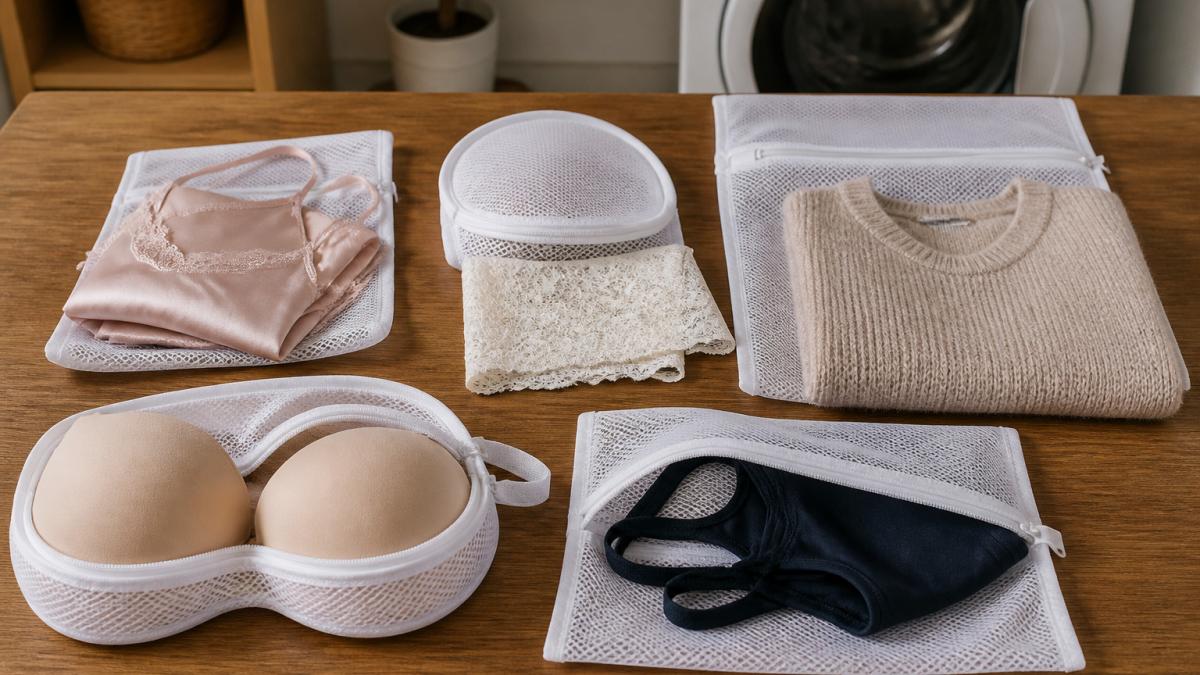
Fabric type should drive your choice. A bag that works for a cotton tee may tear a delicate sports bra strap. The table below maps the most common delicates to the bag that protects them best, then the sections that follow explain the reasoning and the sizing math.
| Fabric or item | Recommended bag | Mesh type | Why it works |
|---|---|---|---|
| Silk blouses, camisoles | Small fine-mesh bag, one garment per bag | Fine (tight weave) | Smooth, tight weave reduces friction and prevents pulls; one item per bag stops self-abrasion |
| Lace, sheer panels, hosiery | Fine-mesh bag with a guarded zipper | Fine | Keeps hooks and straps from catching; guard stops the zipper from snagging lace |
| Wool sweaters, knitwear | Medium double-layer mesh bag | Double-layer | Extra layer absorbs abrasion during a weekly wash and keeps small pieces from slipping through |
| Bras (including sports bras) | Dedicated bra bag or bra compartment | Fine weave, sealed closure | Holds cups and underwires in shape and keeps hooks from grabbing other fabric |
| Activewear (leggings, tops) | Medium mesh bag, loosely packed | Medium | Contains stretch fabric without trapping water or crowding the load |
| Bulky training layers | Large mesh bag or laundry net | Medium to coarse | Gives bulky items room to move so the mesh is not stretched |
Fine mesh for sheer fabrics and hosiery
Fine mesh suits sheer pieces, hosiery, and lightweight knits. Its tight weave keeps straps and thin fibers from catching on the drum or on zippers. Use fine mesh for anything that pills or runs easily.
Double-layer mesh for knitwear and heavier pieces
Double-layer mesh holds up better for thicker knitwear and heavier training layers.
Sizing: how big should the bag be?
Sizing is where most damage happens, because an overfilled bag defeats its own purpose. Fill a bag no more than about two-thirds full, and leave some slack at the top so garments can shift without straining the mesh or the closure. Match the bag to the item rather than the load, a single bra belongs in a small bra bag, not a large net shared with towels. If you can feel the garment pressing against the mesh when you close the bag, it is too full.
Closure failures to watch for
Closures are the second most common failure point after overfilling. Zippers should lie flat or sit behind a fabric guard so teeth cannot catch on lace or hosiery. Drawstrings work for lighter loads but can loosen during a spin cycle, so tie a double knot and tuck the ends inside the bag. Before washing, fasten hooks and clasps and check that the zipper pull is fully seated; a half-closed zipper is the single most common cause of a snagged garment.
Laundry Bags for Bras and Lingerie
Sports bras are the most common casualty in an unprotected wash. Underwires, hook closures, and thin straps all snag easily. A dedicated bra bag with a fine weave and a sealed zipper prevents most of that damage.
Place one bra per compartment or bag where possible. Clasps can grab neighboring fabric, and a single bag stuffed with several bras increases friction. Fasten hooks before washing to limit tangling.
Washing Bag for Activewear: Sweat, Stretch and Heavy Use
Activewear carries sweat, salt, and oils that break down elastic over time. Washing it inside a protective bag does not remove those residues on its own, but it reduces mechanical stress on stretch fabric, which is often where wear shows first.
Heavy use calls for sturdier construction. Choose reinforced seams and a durable zipper, and avoid overloading the bag. A crowded bag stretches its mesh and strains the closure. Wash activewear in cool water on a gentle cycle, and skip fabric softener, which can coat moisture-wicking fibers.
How to Use a Mesh Laundry Bag Correctly
Using the bag correctly matters as much as buying a good one. Most competitors stop at "zip it and wash on gentle," but the details below, loading, separating, detergent, washer settings, and dryer rules, are where delicates actually get saved or ruined.
Loading and separating
- Sort garments by fabric weight and color, then group similar items in the same bag.
- Fasten hooks, clasps, and straps, and turn embellished pieces inside out.
- Place similar items together, leaving room for water to circulate, no more than about two-thirds full.
- Close the zipper or drawstring fully, and tuck the zipper pull or drawstring ends inside the bag.
- Wash on a gentle cycle in cool water.
Separate by weight, not just by color. A heavy sweatshirt in the same bag as a silk camisole will abrade the silk no matter how good the mesh is. Keep bras in their own bag, hosiery in its own fine-mesh bag, and bulky layers in a larger bag so nothing is compressed.
Detergent and washer settings
Skip fabric softener and dryer sheets on activewear and delicates, because both can coat moisture-wicking fibers and reduce stretch recovery. Choose the gentle or delicate cycle with a low spin speed; a high spin speed is what stretches mesh and strains closures. Cold water protects elastic and reduces dye transfer between garments sharing a bag.
Can laundry bags go in the dryer?
Most mesh laundry bags are dryer-safe on low heat, but the safer default is to air dry delicates and dry the bag separately. High heat is the enemy of both mesh and elastic: it can warp synthetic mesh, shrink cotton mesh, and break down the spandex in sports bras and leggings. If you do tumble, use the lowest heat setting and remove items while slightly damp. Never put a bag containing foam cups or molded bras in a hot dryer.
Cleaning and storing the bags
Rinse bags after each use and air dry them open so mildew does not form in the weave. Wash the bags themselves every few weeks, a quick machine wash in warm water with a small amount of detergent is enough, and check seams and zippers for wear. Store bags flat or hanging, not crumpled, so the mesh does not crease and weaken along fold lines.
care-label guidance for delicate fabrics
Choose Your Delicates Bag Set Before Your Next Wash
Plan your set before your next load. Start with one fine-mesh bag for sheer and lightweight items, one double-layer bag for knitwear, and one bra bag. Add a larger bag for bulkier training layers if you wash those often.
Greatness Wins designs performance apparel meant to last through hard training and regular washing. Pair good garments with a protective wash routine, and they will hold their shape and performance for far longer. Shop all golf and training apparel to see how our pieces are built.
Frequently Asked Questions
What is the best laundry bag for delicates?
The best laundry bag for delicates is a fine or double-layer mesh bag with a zipper that lies flat and a size matched to the garments you wash. Fine mesh suits sheer fabrics and hosiery, while double-layer mesh holds up better to knitwear and heavier activewear. Pricing depends on size and brand, so check current prices directly on the Greatness Wins website before buying.
Do laundry bags actually protect delicate clothes?
Laundry bags can help keep delicate items from catching during the wash cycle. Use a gentle cycle and cold water alongside the bag, and keep the bag loosely filled.
Can you put a laundry bag for delicates in the dryer?
Check the care label on the bag before putting it in the dryer, since high heat can damage some zippers and synthetic meshes. Air drying is generally the safer option for delicates and elastic-heavy activewear.
What size laundry bag is best for bras?
Choose a bag size that gives each garment room to move without crowding, and avoid stuffing bras into bags that are too small.