Table of Contents
- What Makes Athletic Wear Durable for Golf
- Fabric Composition: The Foundation of Durability
- Golf Shirts That Allow Full Swing Range
- Moisture-Wicking Golf Fabric Benefits
- Technical Construction: Seams, Reinforcement, and Stress Points
- How to Care for Performance Golf Apparel
- Why Fit and Ergonomic Design Matter for Durability
- Frequently Asked Questions
Last Updated: September 26, 2026
What Makes Athletic Wear Durable for Golf
Durability in golf apparel isn't accidental. It's engineered. According to Future Market Insights' 2026 Global Golf Outfit Market Report, golf tops account for 34% of the entire golf apparel product segment, and demand for durable, performance-oriented gear continues growing through 2036. But here's what most guides get wrong: they focus on comfort and style while ignoring the biomechanical stress a golf swing places on fabric.
At Greatness Wins, we've analyzed what separates apparel that holds up through hundreds of rounds from pieces that deteriorate after a season. The answer lies in three interconnected factors: fabric composition at the molecular level, technical construction methods that reinforce stress points, and maintenance practices that preserve structural integrity. Understanding what makes athletic wear durable for golf means understanding how synthetic blends, seam engineering, and fiber science work together to withstand repetitive high-torque motion.

Below, we'll break down the specific fabric technologies, construction standards, and care protocols that determine whether your golf shirt lasts two seasons or ten.
Fabric Composition: The Foundation of Durability
The material you choose determines everything that follows. Cotton feels natural, but it fails under the demands of modern golf. Synthetic blends are where durability actually lives.
Nylon-Spandex Blends and Four-Way Stretch
Nylon-spandex blends have become the industry standard for performance golf wear. According to SanSan Sports' 2026 analysis, nylon-spandex with four-way stretch is now the most widely adopted fabric for performance golf wear, replacing traditional cotton. This shift isn't cosmetic, it's structural.
Four-way stretch means the fabric moves in all directions: up-down, left-right, and diagonally. Your golf swing demands exactly this. The backswing pulls fabric across the shoulders and chest. The downswing creates torque through the torso. Without multidirectional stretch, seams tear. Fibers break. The garment loses its shape permanently.
Nylon provides tensile strength, the ability to resist tearing under stress. Spandex provides elasticity, allowing the fabric to recover its original shape after being stretched. Together, they create a fabric that bends without breaking and returns to form without permanent deformation. This is what makes athletic wear durable for golf at the fiber level.
Optimal Spandex Ratios for Long-Term Performance
Not all spandex ratios are created equal. According to Fuway Golf's 2026 industry recommendations, golf polos should contain 5-8% spandex to achieve the ideal balance between stretch and long-term durability. Spandex content exceeding 10% is generally reserved for specialized athletic performance lines where high-intensity movement is prioritized over garment longevity.
Here's why this matters: spandex degrades faster than nylon under UV exposure and repeated washing. Higher spandex ratios mean faster breakdown. A polo with 12% spandex might feel incredible on day one, maximum stretch, maximum recovery. But after 40 washes, that elasticity collapses. The fabric becomes baggy and loses its ability to return to shape.
The 5-8% sweet spot delivers enough stretch for a full golf swing without sacrificing longevity. You get the mobility you need without accelerating degradation.
Recycled Materials and Performance Balance
Sustainability and durability aren't opposites. According to Berun Activewear's 2026 fabric analysis, a 90-95% recycled polyester (rPET) and 5-10% spandex knit blend is currently identified as a leading material choice. This composition provides moisture-wicking properties, abrasion resistance, and durability that performs within 10-20% of virgin synthetic materials.
Recycled polyester performs nearly as well as virgin polyester because the recycling process doesn't fundamentally alter the polymer structure. What changes is the supply chain: recycled materials come from reclaimed plastic bottles and textile waste, not petroleum extraction. The resulting fabric maintains tensile strength, resists pilling, and handles repeated washing without significant degradation.
The Greatness Wins Clubhouse Pant uses this exact principle, made from recycled plastic water bottles with two-way stretch and DWR water repellency. You get durability without compromise.

Golf Shirts That Allow Full Swing Range
Durability and mobility are inseparable. A shirt that restricts your swing creates compensatory tension that accelerates fabric breakdown in high-stress zones.
The ideal golf shirt moves with your body, not against it. Restrictive armholes force the shoulder seam to absorb extra stress during the backswing. Tight chest panels create pressure points where fibers fray. Stiff collars dig into the neck, creating localized wear.
Ergonomic design, where seams are positioned to follow the body's natural range of motion, reduces mechanical stress on the fabric itself. When a shirt fits your body correctly, stress distributes evenly across the garment rather than concentrating at pressure points. This even distribution is the primary reason custom-fit apparel lasts longer than standard cuts.
The Athletic Tech Polo from Greatness Wins demonstrates this principle: extremely lightweight construction with maximum stretch allows full range of motion without restricting the swing. This design philosophy directly extends garment life by preventing compensatory tension and localized stress concentration.

Moisture-Wicking Golf Fabric Benefits
Moisture management is a durability factor most people overlook. Sweat accelerates fabric degradation through two mechanisms: chemical breakdown and microbial growth.
How Moisture-Wicking Extends Garment Life
Moisture-wicking fabrics pull sweat away from the skin and move it to the outer surface where it evaporates. This process does two things for durability: it reduces the time sweat stays in contact with fibers, and it prevents the warm, moist environment that encourages mold and mildew growth.
Sweat contains salts and amino acids that, when trapped in fabric, create an acidic microenvironment. Over time, this acidic environment breaks down the polymer chains in synthetic fibers. The fabric becomes brittle. Colors fade. The garment loses its structural integrity.
By moving sweat away from the fiber surface, moisture-wicking fabrics reduce this chemical exposure. Additionally, a dry fabric resists bacterial and fungal colonization, which would otherwise weaken fibers and create odor that persists through washing.
The Classic Sport Polo from Greatness Wins uses highly breathable pique construction with open weave that enables strong airflow and helps manage body temperature. This construction simultaneously improves performance and extends garment lifespan by keeping moisture away from fiber surfaces.
Technical Construction: Seams, Reinforcement, and Stress Points
Fabric quality is only half the equation. How the fabric is assembled determines whether durability translates to real-world longevity.
Abrasion Resistance and Anti-Snag Properties
Abrasion resistance is the fabric's ability to resist surface wear from rubbing and friction. Golf creates specific abrasion patterns: the inside of the arms rub against the torso during the swing. The collar rubs against the neck. The hem rubs against the waistband.
Anti-snag properties prevent individual fibers from catching and pulling loose. A single snag can cascade into a run that destroys the garment. High-quality knit density, the number of fibers per square inch, directly correlates with snag resistance. Tightly knitted fabrics have less space for fibers to catch and pull.
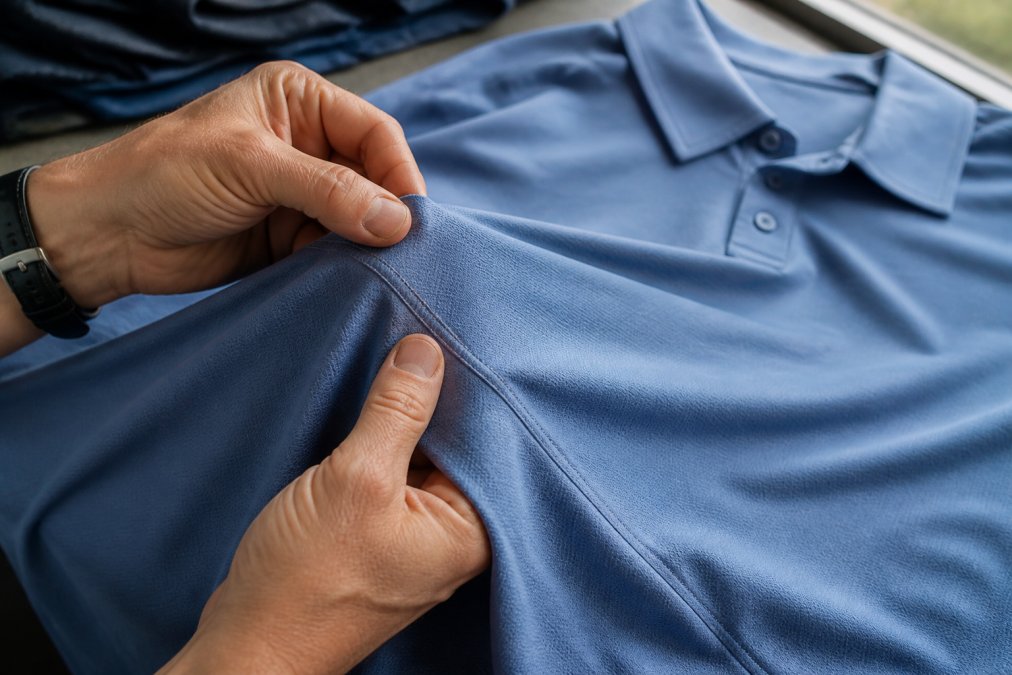
Technical construction standards for durable golf apparel include reinforced seams at high-stress points: armholes, shoulder seams, and collar attachments. Double-stitching or box-stitching (where the seam is reinforced with an additional perpendicular stitch) prevents seams from separating under load.
UV Protection and Colorfastness
UV exposure degrades synthetic fibers. Ultraviolet radiation breaks polymer chains, causing the fabric to become brittle and lose color. Golf happens outdoors, often in direct sunlight for 4-5 hours at a time. A durable golf shirt must resist UV degradation.
How to Care for Performance Golf Apparel
Durability is built into the fabric and construction, but maintenance determines whether that durability translates to years of wear.
| Care Practice | Impact on Durability | Frequency |
|---|---|---|
| Cold water wash | Preserves fiber structure and elasticity | Every wash |
| Air dry or low heat | Prevents spandex degradation | Every wash |
| Inside-out washing | Reduces surface abrasion and pilling | Every wash |
| Mild detergent only | Prevents chemical fiber breakdown | Every wash |
| Avoid bleach and softeners | Maintains moisture-wicking and elasticity | Every wash |
| Fold storage | Prevents permanent shoulder seam stretch | Between wears |
Why Fit and Ergonomic Design Matter for Durability
This is where most conversations about durability stop short. Fit determines how stress distributes across the garment during movement.
Frequently Asked Questions
What fabric is best for durable golf shirts?
Nylon-spandex blends with 5-8% spandex content provide the ideal balance between stretch and durability for golf apparel. This composition delivers four-way stretch for full swing mobility while maintaining shape retention through repeated wear and washing. Recycled polyester (rPET) blends with 5-10% spandex are also gaining traction in 2026, offering moisture-wicking properties and abrasion resistance that perform within 10-20% of virgin synthetic materials, making them a durable and sustainable choice.
Do golf shirts need to be moisture-wicking for durability?
Yes. Moisture-wicking fabrics extend garment life by reducing moisture retention, which causes bacterial growth, odor buildup, and fabric degradation over time. Technical moisture-wicking technology also prevents the fabric from becoming heavy and stressed during intense play. This property is especially critical for golf apparel, where thermal regulation and repeated mechanical stress from the swing demand fabrics that manage sweat efficiently while maintaining structural integrity.
How should I care for performance golf apparel to maximize durability?
Wash golf apparel in cold water on a gentle cycle to preserve seam integrity and fabric elasticity. Avoid high heat in the dryer, which breaks down synthetic fibers and spandex. Turn garments inside out before washing to reduce pilling and abrasion on the outer surface. Air dry when possible. Store in a cool, dry place away from direct sunlight to maintain colorfastness and prevent UV-induced fiber degradation. Proper care extends the lifespan of high-performance fabrics significantly.
What makes golf apparel from Greatness Wins built to last?
Greatness Wins designs golf apparel with reinforced seams, moisture-wicking technology, and high-quality synthetic blends engineered to withstand the mechanical stress of a full golf swing. Products like the Athletic Tech Polo feature superior moisture-wicking and maximum stretch for full range of motion, while the Clubhouse Pant uses lightweight, wrinkle-free fabric with two-way stretch and DWR water repellent treatment. These technical construction methods maintain structural integrity through frequent washing and intense use.