Last Updated: November 9, 2026
Quick Summary
Merino wool is a fine-diameter natural fiber that regulates body temperature, manages moisture, and resists odor during exercise better than cotton or standard synthetics. Research from Australian Wool Innovation's 2025 breathability summary found that wool buffers moisture 45% better than cotton and 26% better than viscose, making it a genuinely different material rather than a marketing story.
- Merino base layers delivered 96% better moisture buffering than polyester in NCSU testing.
- Choose fabric weight of 150-190 gsm for hot training and 200-260 gsm for cold sessions.
- Blend with 10-20% nylon or elastane to protect durability and shape recovery.
- Wash cold on a gentle cycle with wool-safe detergent and always air dry flat.
- Wear merino two to three times between washes for low-sweat sessions.
Table of Contents
- Why Merino Wool Outperforms Cotton and Synthetics
- Merino Wool Workout Shirt: What to Look For
- Merino Wool Exercise Clothes: Base Layers and Beyond
- Merino Wool Socks: Blister Prevention and Comfort
- Working Out in Merino Wool: Practical Tips and Care
- Merino vs. Synthetic Fabrics: A Side-by-Side Comparison
- Choosing Merino Gear for Your Training Style
- Frequently Asked Questions
Why Merino Wool Outperforms Cotton and Synthetics
Merino wool is a fine-diameter natural fiber that regulates body temperature, manages moisture, and resists odor during exercise better than cotton or standard synthetics. Research from Australian Wool Innovation's 2025 breathability summary found that wool buffers moisture 45% better than cotton and 26% better than viscose, making it a genuinely different material rather than a marketing story.
That matters because the average workout shirt fails at exactly the moment you need it most: the recovery interval. Cotton soaks and stays soaked. Polyester moves sweat away but turns ripe fast. Merino sits between the two and outperforms both on thermal comfort.
Thermoregulation and Dynamic Breathability
Thermoregulation is the body's ability to hold a stable core temperature, and merino supports it through dynamic breathability: the fiber responds to your sweat output in real time.
Stop-go sports are the hardest test. Golf, tennis, interval training, and cycling all swing between hard exertion and full recovery, and that's where synthetics struggle. A 2025 summary in Beyond the Bale, issue 104 reports that athletes wearing wool expend less energy maintaining thermal comfort. Less energy spent on temperature control is energy available for performance.
Moisture Management and Odor Resistance
Odor resistance comes from the fiber's structure. Wool absorbs odor molecules and releases them on washing, which is why merino survives multiple wears between laundry days. Synthetics, by contrast, host the bacteria that cause sweat degradation and hold the smell permanently. For anyone training daily, that difference alone changes the laundry math.
Merino Wool Workout Shirt: What to Look For
A merino wool workout shirt should be judged on micron count, fabric weight, and seam construction, not on the wool content percentage alone. Here's what actually separates a good training shirt from an expensive one:
- Micron count under 19 microns. Finer fiber means less itch. Anything above 21 microns starts to feel scratchy against bare skin during heavy sweat.
- Fabric weight of 150-190 gsm for hot training. Heavier knits belong in cold-weather base layers, not summer sessions.
- Flatlock or raglan seams. Shoulder seams that sit under a pack strap or golf swing will chafe over 18 holes.
- Blend with 10-20% nylon or elastane. Pure merino stretches out; a small synthetic addition protects garment durability and recovery.
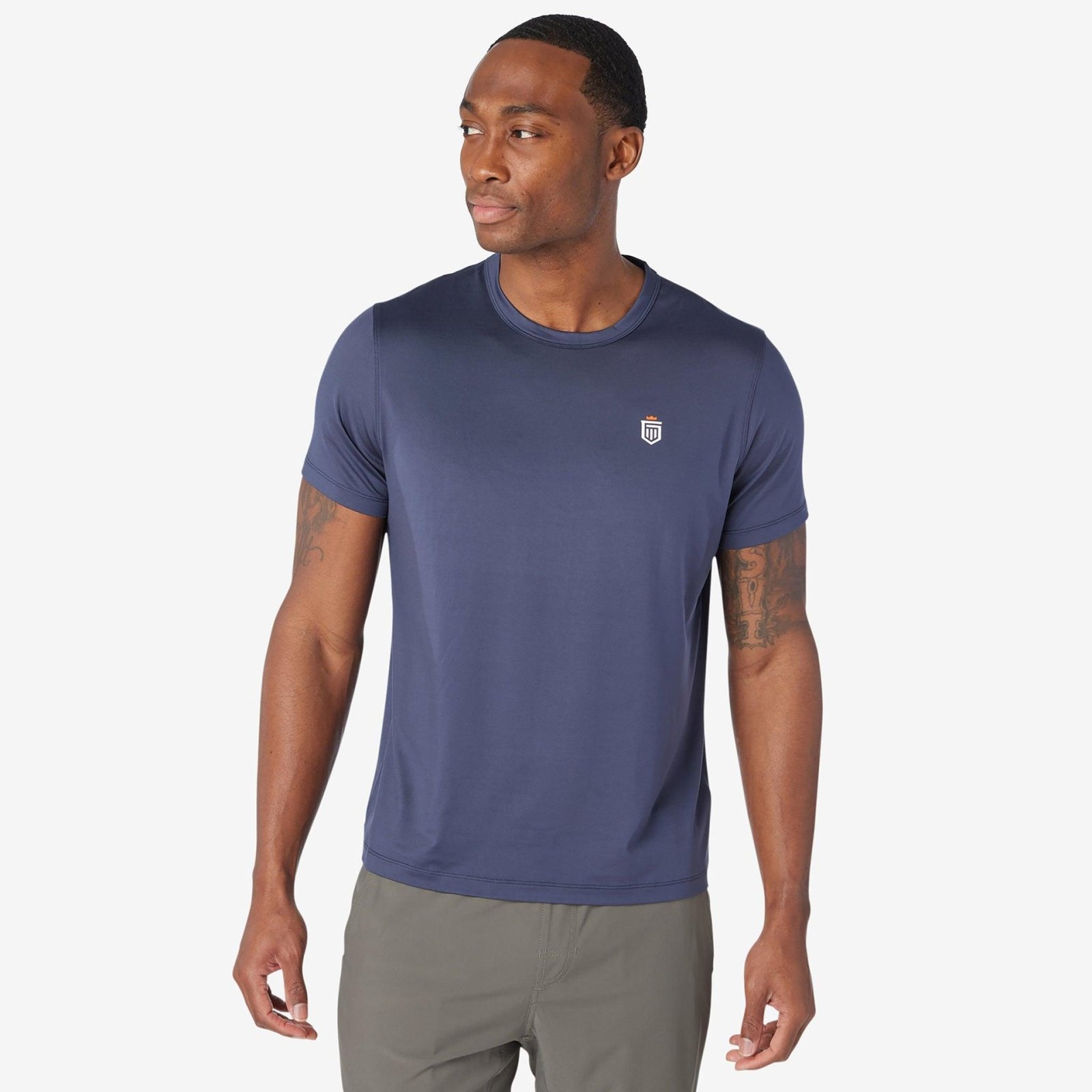
Explore our Performance Training Tee for training in warm conditions. Watch out: a shirt labeled "merino blend" with 5% wool content is a synthetic shirt with a marketing label. Check the fiber breakdown on the tag before you buy.

Merino Wool Exercise Clothes: Base Layers and Beyond
Merino wool exercise clothes now cover the full kit: short-sleeve tees, long-sleeve base layers, quarter zips, and shorts. But the reason merino works as a system, and the reason most athletes get it wrong, is that each layer is doing a different job with the same fiber. Understanding those jobs is what separates a kit that performs from a drawer of expensive wool.
The three jobs of a merino layering system
A base layer sits against skin and owns moisture management. Its job is to move sweat vapor off the body and buffer the microclimate between skin and fabric so you don't swing from wet-and-cold to overheated.
A mid layer owns insulation and temperature buffering.
An outer layer owns weather protection and doesn't need to be merino at all. A shell over a merino base and mid layer is a common and sensible combination; the wool handles the moisture and temperature work underneath.
Match the layer to the sport, not the season
Most guides tell you to buy by temperature. A more useful framework is to buy by effort pattern, because merino's advantage is largest where your output swings.
- High-intensity, steady-output sports (running, cycling, HIIT): you sweat heavily and continuously, so moisture movement matters more than insulation. A 150-170 gsm short-sleeve tee with flatlock seams is the workhorse. You'll generate your own heat within minutes, so overdressing is the bigger risk.
- Stop-go sports (golf, tennis, interval training): these are merino's strongest case. You alternate hard exertion with full recovery, and the fiber's moisture buffering keeps you from chilling during the recovery intervals. A lightweight polo or tee with a raglan shoulder for swing and reach mobility is the right pick.
- Low-intensity, long-duration activities (hiking, rucking, cold-weather training): output is lower and steadier, so insulation and odor control dominate. A 200-260 gsm long-sleeve base layer plus a quarter zip covers most conditions, with a shell for weather.
- Everyday gym work: merino socks and a mid-weight tee cover most sessions without overbuying.
A common mistake is buying one heavy merino piece and expecting it to work year-round. Merino performs across a wide temperature band, but weight still matters. Build a small rotation, one lightweight tee, one mid-weight long-sleeve, one quarter zip, instead of one do-everything item.
Why merino is almost always blended
Pure merino is soft and temperature-smart, but it is not the most abrasion-resistant fiber on its own.
Watch out: a shirt labeled "merino blend" with 5% wool content is a synthetic shirt with a marketing label.
Browse the full performance tee collection for hot-weather training, or look at the Performance Training Quarter Zip for cooler sessions. Merino works as a system, and each layer has a job.
Merino Wool Socks: Blister Prevention and Comfort
Cushioning under the forefoot helps for running and golf, where pressure points are predictable. Pair them with performance training shorts that ventilate well, and your lower half is handled. One caveat: merino socks still need air drying. Tumble dryers shrink them and break down the fiber faster than washing does.
Working Out in Merino Wool: Practical Tips and Care
Working out in merino wool works best when you treat it like technical gear, not like a cotton t-shirt. The fiber is durable, but it is durable in specific ways, and most merino gear dies early not from sweat but from heat, agitation, and the wrong detergent. Here is how to get years out of a piece instead of months.
Washing: the mechanics that matter
- Wash cold on a gentle or wool cycle. Heat is the enemy. Hot water causes the fiber's scales to interlock and the knit to shrink and felt, and it degrades the elastic performance of any elastane in the blend. Cold water cleans merino perfectly well because wool releases odor and soil readily.
- Use a wool-safe, pH-neutral detergent. Wool care guidance generally recommends a wool-specific detergent.
- Skip fabric softener and bleach entirely. Softener coats the fiber and reduces its ability to buffer moisture, which is the whole point of wearing it. Bleach damages wool outright.
- Turn garments inside out and use a mesh bag for anything with a high wool content. This reduces surface abrasion in the drum, which is the main cause of pilling.
Drying: why air drying is non-negotiable
Air dry flat or hang. Never tumble dry. A dryer combines heat and tumbling, the two things that shrink and felt wool fastest, and it breaks down elastic fibers in blends. Lay knits flat to dry so they keep their shape; hang heavier pieces only if the fabric can take the weight without stretching at the shoulders.
Watch out: merino socks and base layers still need air drying. A single tumble cycle can shrink a wool sock enough to change its fit, and repeated dryer use is the fastest way to turn a soft merino tee into a scratchy one.
Wearing: the laundry math
Wear it two to three times between washes for low-sweat sessions. Odor resistance is real, wool absorbs odor molecules and releases them on washing, and over-washing is the fastest way to wear merino out. For high-sweat sessions, rinse in cold water and hang to dry between wears; that resets the garment without a full wash cycle.
Storage and repair
Store folded, not hung. Hangers stretch knit shoulders over time, and a stretched shoulder is hard to reverse. Keep merino away from moths in off-season storage, cedar or a sealed bin works, because wool is a natural protein fiber and moths know it.
Small holes and snags are fixable. A snag can usually be worked back into the knit with a blunt needle; a small hole can be darned before it grows. Catching damage early is the difference between a repair and a replacement.
What most guides miss
Merino's natural elasticity recovers after washing, so a shirt that feels slightly loose after a long session usually snaps back. Don't size down to compensate, buy your normal size and let the fiber do its job. And don't judge longevity by the first month: a well-cared-for merino piece typically outlasts a comparable synthetic because it doesn't hold odor and doesn't need frequent hot washing. Treat it like technical gear, and the cost per wear drops every season you keep it in rotation.
Merino vs. Synthetic Fabrics: A Side-by-Side Comparison
Merino and synthetics each have different strengths depending on your sport and how often you wash your kit.
| Factor | Merino Wool | Synthetic (Polyester) |
|---|---|---|
| Moisture buffering | 96% better than polyester in NCSU testing | Fast wicking, poor buffering |
| Odor resistance | Naturally antimicrobial, multi-wear | Retains odor permanently |
| Thermal comfort in stop-go | Superior (AWI, 2025) | Overheats then chills |
| Dry time | Slower | Fastest |
| Durability | Good with blends, prone to abrasion | High abrasion resistance |
| Skin feel | Soft at low micron counts | Smooth but clammy when saturated |
For a deeper look at how construction affects performance, read our breakdown of athletic wear fit versus fabric tech. The short version: fabric tech sets the ceiling, but fit determines whether you ever reach it.
Choosing Merino Gear for Your Training Style
Pick merino by matching fabric weight to your sport and climate, not by brand loyalty. Here's the framework:
- Hot-weather running and HIIT: 150-170 gsm short-sleeve tee, minimal seams.
- Golf and tennis: lightweight polo or tee with a raglan shoulder for swing mobility.
- Cold-weather training and hiking: 200-260 gsm long-sleeve base layer plus a quarter zip.
- Everyday gym work: merino socks and a mid-weight tee cover most sessions.
A common mistake is buying one heavy merino piece and expecting it to work year-round. Merino performs across a wide temperature band, but weight still matters. Build a small rotation instead of one do-everything item.
Merino only delivers when the garment is cut for movement, and that's the harder half of the problem. Greatness Wins builds premium performance apparel for athletes who train seriously, with featherweight breathable fabrics, consistent sizing across the range, and free shipping on orders over $100 plus free returns within the U.S. Get started with Greatness Wins and train in gear that keeps up with every interval.
Frequently Asked Questions
Is Merino wool good for athletic wear?
Yes. Merino wool regulates temperature, manages moisture, and resists odor. Merino wool is widely regarded as a strong performer for moisture management and comfort during stop-go sports.
What are the downsides of Merino wool?
Merino can be more expensive than synthetic alternatives and requires careful washing to avoid shrinkage. Some people find it less durable than polyester in high-friction areas, and it may pill over time. However, proper care and blending with synthetic fibers can extend its life and performance.
How should you wash Merino wool athletic apparel?
Wash merino wool in cold water on a gentle cycle with a wool-specific detergent. Avoid fabric softeners and bleach. Lay flat to dry away from direct heat. This preserves fiber integrity and prevents shrinkage, helping your gear last through many workouts.
Is Merino wool better than synthetic fabric for workout clothes?
Merino offers natural thermoregulation, odor resistance, and moisture management without the plastic feel of synthetics. Synthetics generally dry faster, while merino is valued for odor resistance. The best choice depends on your activity and care preferences.