Last Updated: November 21, 2026
Quick Summary
Eco-friendly disposal of worn out activewear starts with checking whether it can still be worn, repaired, or passed on. Items that still fit and hold up can be kept or donated, small damage can be mended, and only heavily worn pieces should go to textile recycling.
- Check for stretched waistbands, thinning fabric, pilling, holes, and lingering odor after washing.
- Mend small tears, loose seams, or broken zippers before deciding to discard an item.
- Donate, resell, or swap wearable pieces, after washing and confirming fit and fabric.
- Check the care label fiber mix: 100% polyester is easiest to recycle, while blends are often rejected or downcycled.
- Wash and fully dry items, and confirm a program's acceptance before dropping off or shipping.
Table of Contents
- Start With a Quick Check: Is Your Activewear Still Wearable?
- Step 1: Repair or Mend Gear That Still Has Life
- Step 2: Donate, Resell or Swap Wearable Pieces
- How to Identify Recyclable vs. Non-Recyclable Synthetic Fabrics
- Step 3: Find Textile Recycling Programs Near You
- What to Do With Old Clothes That Cannot Be Donated
- Preparing Your Worn-Out Activewear: A Checklist and Your Next Step
- Frequently Asked Questions
Start With a Quick Check: Is Your Activewear Still Wearable?
Before you throw out worn out activewear, check whether it still has life in it. Most activewear that looks tired can still be worn, repaired, or passed on. Worn-out is not the same as unusable.
Start with a simple test. Look for stretched waistbands, thinning fabric, pilling, and holes. Check whether the fit has changed, and whether odor stays after washing. A garment that still fits and holds up for workouts is a good candidate to keep or donate.
Here is a quick decision guide:
- Still wearable: Good fit, no holes, no strong odor. Keep it, repair it, or donate it.
- Needs repair: Small tears, loose seams, or a broken zipper. Mend it first.
- Done wearing: Large holes, fabric that has broken down, or permanent stains. Move to recycling.
Note that we recommend keeping your garments in use as long as they perform well. Our guide on how to extend the life of workout clothes covers simple habits that slow wear. For a benchmark, see how long quality workout clothes should last.
Step 1: Repair or Mend Gear That Still Has Life
Repair is the first step for worn out activewear with a fixable problem. A small tear or loose seam can often be sewn in an hour with basic supplies. Mending keeps a garment out of the waste stream and saves you money.
Start with a needle, thread that matches the fabric, and a small pair of scissors. Use a stitch that holds the stretch of activewear, such as a narrow zigzag. For a broken elastic waistband, replacing the elastic is usually cheaper than buying new gear.
If the damage is beyond home repair, a tailor or alterations shop can often help. Ask whether they handle technical fabrics before you drop off the item.
If a piece still has real problems after a repair, step-by-step guidance on snag repair can help you decide what to do next.
Step 2: Donate, Resell or Swap Wearable Pieces
Clothes that still work for training can go to someone else. Donation, resale, and swaps keep useful gear in circulation longer.
Here are the main options:
- Donate to a local shelter, school athletic program, or community clothing drive.
- Resell through a consignment shop or an online marketplace.
- Swap with friends, teammates, or a workout group.
Before you donate, wash the item and check the fit and fabric once more. Note that many donation centers only accept clean, wearable clothing. Items with stains or odors are usually refused.
How to Identify Recyclable vs. Non-Recyclable Synthetic Fabrics
Most activewear is built from synthetic fibers, and the fiber mix determines whether a garment can be recycled, downcycled, or only discarded. Our article on whether synthetic sportswear sheds microplastics explains how these fibers shed and how that affects disposal decisions. Knowing what is on the care label, and what that means for processing, is the difference between a useful drop-off and a wasted trip.
The main synthetic fibers in activewear behave differently at end of life:
- Polyester: The most common fiber in activewear. It is the easiest synthetic to recycle because many mechanical and chemical recyclers can process it, especially when it is clean and separated from other materials.
- Nylon: Strong and stretchy, and recyclable in principle, but it often appears in blends that complicate sorting. Clean, single-fiber nylon has better acceptance than nylon mixed with spandex.
- Spandex (elastane): Added for stretch, usually at 5-20% of a blend. Even small amounts can disrupt recycling because spandex does not melt or process at the same temperatures as polyester or nylon.
- Blends: A polyester-elastane leggings or a nylon-spandex sports bra is a mixed-fiber garment. Most mechanical recyclers cannot separate the components cleanly, so many programs either reject blends or route them to downcycling rather than fiber-to-fiber recycling.
Check the care label for fiber content and percentages. A tag that reads "88% polyester, 12% spandex" tells you the garment is a blend and may face limited acceptance. A tag that reads "100% polyester" is a stronger candidate for fiber-to-fiber recycling. If the label lists three or more fibers, assume the item is hard to recycle until a program confirms otherwise. Because blended fibers can complicate sorting, the same careful label check can help when you recycle old clothes made from other materials.
Understand what happens after collection. Fiber-to-fiber recycling turns old textiles into new textile fibers, which is the highest-value outcome. Downcycling turns them into lower-grade products such as insulation, wiping cloths, or padding. Some programs simply incinerate or landfill what they cannot process. Ask the program which outcome applies to activewear blends before you hand over your gear.
Watch out: a bin labeled "textile recycling" does not guarantee fiber-to-fiber processing. Some collection programs sort out wearable items for resale and send the rest to downcycling or disposal, so confirm the end market rather than assuming the best case.
Recycling is generally the best end-of-life step, not a reason to buy more.
The fiber mix on a garment's label largely decides whether it can be recycled, downcycled, or only discarded.
| Fiber | Recycling outlook | Why |
|---|---|---|
| Polyester | Easiest to recycle | Many recyclers can process it, especially when clean and separated |
| Nylon | Recyclable in principle | Often mixed in blends that complicate sorting |
| Spandex (elastane) | Disrupts recycling | Does not process at the same temperatures as polyester or nylon |
| Blends | Often rejected or downcycled | Mechanical recyclers cannot cleanly separate the components |
Step 3: Find Textile Recycling Programs Near You
Textile recycling programs take worn-out clothing that cannot be reused.
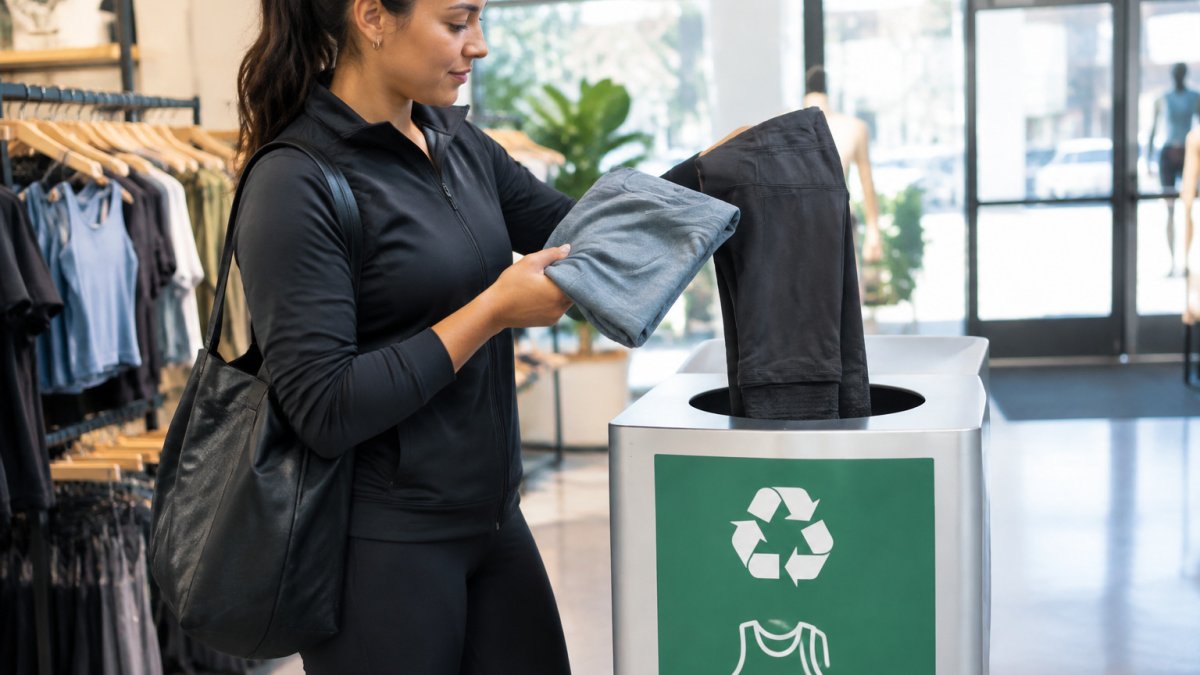
To find a program near you:
- Check with your city or county waste department for textile drop-off sites.
- Look at brand take-back programs, which accept their own products.
- Search for specialty recyclers that accept activewear and synthetic blends.
What to Do With Old Clothes That Cannot Be Donated
Some garments are too damaged for donation or resale. These pieces still have options.
Consider these alternatives:
- Upcycle them into rags, pet bedding, or padding for storage projects.
- Repurpose a sports bra or leggings as cleaning cloths.
- Recycle them through a textile program if one accepts your fiber type.
Use the least-effort option that still keeps the item out of the trash.
Never place textiles in curbside recycling unless your local program lists them as accepted. Many programs do not take clothing, and it can damage sorting equipment.
Preparing Your Worn-Out Activewear: A Checklist and Your Next Step
Preparation determines whether a donation center or recycler accepts your gear. Activewear needs more care than everyday clothing because sweat, odor, and stretch fabrics affect acceptance and processing.
Follow these steps before any drop-off or mail-in shipment:
- Wash and dry completely. Wash each item according to its care label and dry it fully. Damp items can grow mold in storage and are routinely rejected.
- Deal with odor and contamination. If odor persists after washing, do not donate the item. Heavy sweat, mildew, or chemical contamination (such as motor oil or paint) makes a garment unsuitable for reuse and often for recycling.
- Remove non-textile parts when asked. Some programs want metal zippers, plastic clasps, and drawstring aglets removed; others prefer them left on for their own sorting. Check the program's instructions before you alter the garment.
- Sort by fiber and type. Keep single-fiber items separate from blends, and bundle leggings, tops, and sports bras by category so staff can process them faster.
- Note the fiber content. Write the fiber mix on a sticky note or keep the care label attached so the program can confirm acceptance.
- Bag or box appropriately. Use a clean, dry bag or box. Keep wet or moldy items out of the bundle entirely.
Verify acceptance before you go. Check the program's accepted-items list for the words "activewear," "sportswear," or "synthetic blends." Call or check the website to confirm whether polyester-elastane and nylon-spandex items are accepted, and ask whether the program recycles fiber-to-fiber or downcycles. For mail-in programs, confirm shipping requirements, weight limits, and whether you pay postage.
Watch out: a program that accepts "clothing" may still reject stretchy activewear or heavily worn items. Confirm the specific garment type and condition before you ship or drive to a drop-off.
Once your gear is ready, pick one route from this guide and act on it this week. Start with the item that is easiest to repair or donate, then move to recycling for the rest.
Ready to build a wardrobe that lasts longer? Shop Greatness Wins for durable performance apparel designed to hold up through training and competition.
Frequently Asked Questions
Can worn-out activewear be recycled?
Often, yes, but not always through curbside bins. Synthetic blends such as polyester, nylon and spandex are harder to process than cotton, so look for brand take-back programs or specialty textile recyclers that accept technical fabrics. Check that the program explicitly lists activewear or synthetics before you send anything. Garments that are heavily soiled, moldy or badly damaged may need to go to general waste, so inspect each piece first.
Should you donate activewear with small holes or stretched elastic?
Usually not to a donation center. Thrift stores generally sell only clothing in good, wearable condition, and gear with small holes or stretched waistbands tends to be rejected or thrown out. Those pieces are better routed to a repair attempt, a textile recycling program, or a repurposing project. A quick test works well: if you would not feel comfortable handing the item to a friend for training, it belongs in another category.
What can I do with old leggings?
Old leggings can be cut into rags for cleaning, used as padding for moving or packing fragile items, turned into pet bedding stuffing, or repurposed as plant ties in the garden. If the fabric is intact but the waistband has stretched out, you can sometimes replace the elastic. When none of those options work, a textile recycling program that accepts synthetic blends is the most responsible next step.
What should you do with old sports bras?
Sports bras with worn-out compression or stretched straps are generally not donatable, but many brands and textile recyclers accept them through take-back programs. Before recycling, cut off the metal hardware and any plastic clasps if the recycler requires it, since these can interfere with fiber processing. Keep the fabric body for recycling and set the hardware aside for general waste or metal recycling, depending on local rules.