Table of Contents
- Why Most Golf Shirts Restrict Your Swing
- What to Look for in Golf Shirts That Allow Full Swing
- Best Moisture-Wicking Golf Shirts: What the Fabric Must Do
- Golf Shirt Fit Guide: Athletic Fit vs. Traditional Fit
- How to Choose Golf Apparel for Mobility: A Step-by-Step Checklist
- Layering Compatibility and UPF Sun Protection
- Care and Maintenance for Performance Golf Shirts
- Conclusion
Last Updated: August 21, 2026
Why Most Golf Shirts Restrict Your Swing
Most golfers blame their swing mechanics before questioning their shirt. The average off-the-rack polo is cut for standing still, shoulders set for neutral posture, side seams positioned for a relaxed torso, and fabric with little to no stretch recovery. During your backswing, that shirt fights you. The shoulders pull, the back panel rides up, and your body compensates rather than completing a full rotation.
According to Grand View Research's U.S. Golf Apparel Market analysis, the U.S. golf apparel market was valued at USD 1.55 billion in 2023, with topwear accounting for over USD 1.5 billion of that figure. A significant portion of those shirts are still designed more for aesthetics than swing biomechanics.
At Greatness Wins, we've built our golf apparel around one non-negotiable: your shirt should never be the reason you leave distance on the fairway.
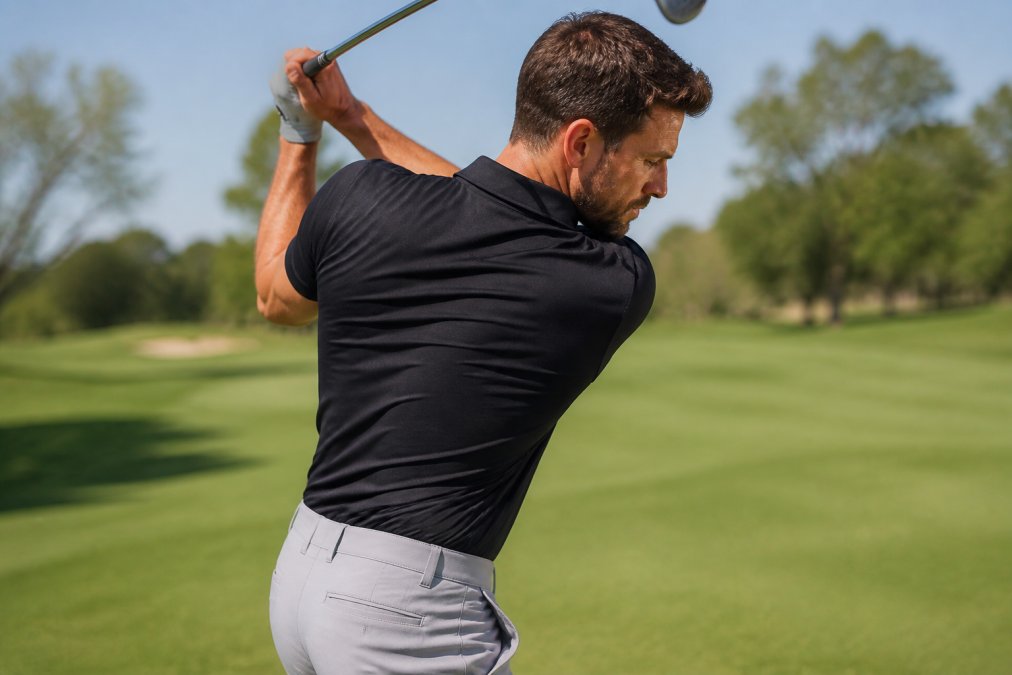
The Biomechanics of Fabric Tension During a Backswing
A full backswing requires the lead shoulder to rotate roughly 90 degrees across the body while the trail shoulder drops and the torso coils against the hips. The shirt must accommodate simultaneous expansion across the upper back, compression across the chest, and vertical elongation through the side panels. Fabric that can't move in all directions creates counter-force that limits rotation depth and forces early extension.
Golfers wearing restrictive shirts tend to shorten their backswing without realizing it, reducing clubhead speed and distance. The restriction is often subtle, a slight tightness at the top that becomes learned compensation over hundreds of rounds. This is why 4-way stretch and articulated shoulder construction aren't marketing buzzwords. They're biomechanical requirements.
What to Look for in Golf Shirts That Allow Full Swing
Golf shirts that allow full swing performance share three specific engineering characteristics.

4-Way Stretch and Fabric Recovery
4-way stretch is the ability of a fabric to stretch both horizontally and vertically, then return to its original shape without distortion. For golf shirts, this is the single most important performance specification.
The stretch component addresses range of motion demand during backswing and follow-through. The recovery component matters equally: fabric that stretches but doesn't snap back will sag and stop performing within a season. Look for fabrics with 5-10% spandex or elastane content blended with polyester for the best combination of stretch, moisture management, and shape retention.
According to Fortune Business Insights' golf apparel market analysis, synthetic materials are projected to capture 46.71% of the golf apparel market share in 2026, driven by this performance advantage over natural fibers.
A simple test: hold the fabric at two corners and pull diagonally. It should stretch easily and return immediately when released. If it resists or doesn't recover, it will restrict your swing.
Shoulder Articulation and Ergonomic Design
Shoulder articulation refers to seam placement and shoulder panel shaping to follow the natural path of arm rotation rather than sitting flat across the top of the shoulder.
Traditional polos place the shoulder seam directly at the acromion, the bony shoulder tip. When you raise your arms into a backswing, that seam gets pulled toward the back, dragging the entire shirt with it. Articulated shoulder construction moves that seam slightly forward and shapes the sleeve head to accommodate rotation rather than resist it.
Ergonomic design also includes side gussets, underarm panels, and back pleats, which add surface area where the body expands during the swing without adding bulk.
Breathability, Ventilation, and Temperature Regulation
Breathability directly affects swing consistency across 18 holes. When body temperature rises and moisture accumulates, muscle performance degrades. According to a January 2026 LifeLabs study cited by Parmore Golf, 84% of golfers prioritize cooling technology when choosing apparel.
Look for mesh ventilation panels positioned across the upper back and underarms, where heat accumulates fastest. Lightweight construction, typically fabrics under 140 grams per square meter, also improves airflow without sacrificing durability.
Best Moisture-Wicking Golf Shirts: What the Fabric Must Do
The best moisture-wicking golf shirts move sweat away from the skin before it accumulates, cool the body through evaporation, and dry quickly enough to keep pace with perspiration during a full round.
Moisture-wicking is a mechanical property, not a coating. Fine, hydrophobic synthetic fibers pull moisture through capillary action toward the outer surface, where it can evaporate. A shirt relying on surface treatment will lose that property after repeated washing. A shirt built from inherently hydrophobic fibers maintains performance wash after wash.
Quick-dry capability complements moisture-wicking. A shirt that wicks sweat to the surface but dries slowly will feel damp by the back nine. The combination of moisture management and fast evaporation separates genuinely technical golf apparel from shirts that simply claim performance credentials.
Synthetic Blends vs. Natural Fabrics: The Performance Tradeoff
Synthetic blends (primarily polyester-spandex) dominate performance golf apparel for good reason: they wick moisture efficiently, dry quickly, hold their shape, and resist shrinkage. The 4-way stretch that backswing mechanics demand is only achievable with synthetic content.
Natural fabrics like cotton are breathable and soft, but they absorb moisture rather than wicking it. Once saturated with sweat, a cotton shirt stays wet, grows heavy, and can restrict movement through sheer weight. Cotton also wrinkles easily and shrinks with washing, making it a poor choice for a shirt that needs to maintain a precise athletic fit round after round.

The practical answer: a high-quality polyester-spandex blend, ideally with anti-odor or antimicrobial treatment, outperforms both pure cotton and untreated synthetic fabrics for on-course use.
| Feature | Polyester-Spandex Blend | Cotton | Cotton-Poly Blend |
|---|---|---|---|
| 4-Way Stretch | Excellent | None | Limited |
| Moisture-Wicking | Excellent | Poor | Moderate |
| Quick-Dry | Excellent | Poor | Moderate |
| Shape Retention | Excellent | Fair | Good |
| Breathability | Good | Excellent | Good |
| Best For | Performance play | Casual wear | Light activity |
Golf Shirt Fit Guide: Athletic Fit vs. Traditional Fit
Fit determines whether a technically excellent fabric translates into unrestricted swing performance on the course.
Athletic fit golf shirts are cut with a slimmer profile through the chest and waist, tapered trouser legs, and articulated shoulders. The silhouette is cleaner and the fabric sits closer to the body. This matters for swing mechanics: excess fabric bunches during rotation, creating the same restriction as a too-tight shirt.
Traditional fit golf shirts have more room through the chest, a straighter side seam, and a longer hem. They're more forgiving for different body shapes but sacrifice the performance advantages of a closer, engineered fit.
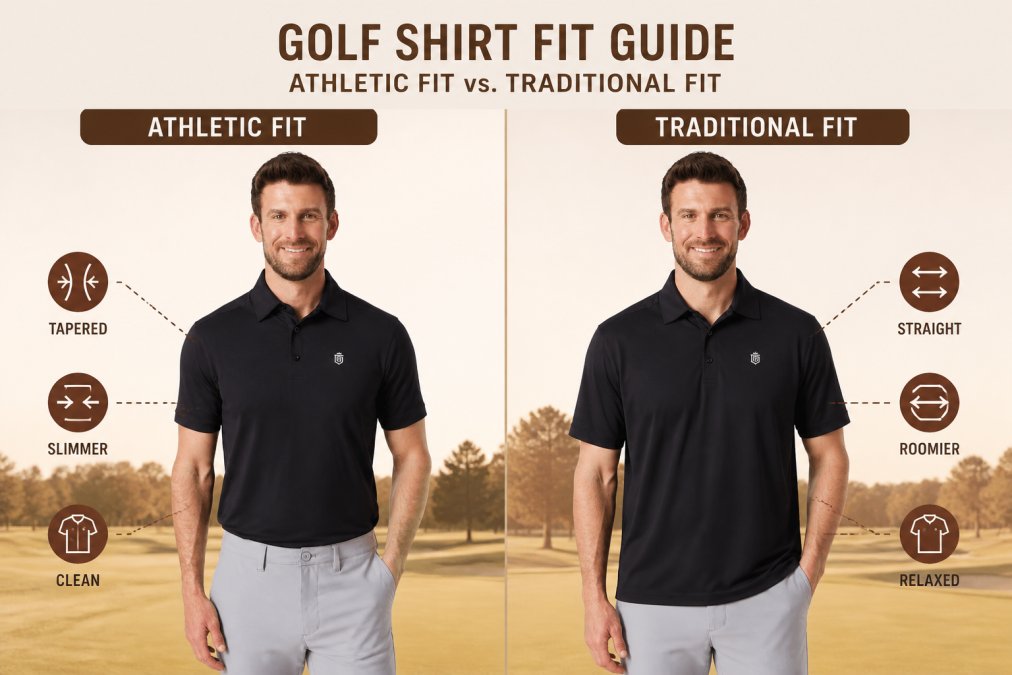
The Greatness Wins Athletic Tech Polo is built on an athletic fit construction with maximum stretch, designed so the closer cut never becomes a restriction. The shirt retails at $99 and is engineered for golfers who play 3-4 times per week.

Body Type Recommendations
- Broader shoulders, narrower waist: Athletic fit works well. Look for articulated shoulders and side seams that taper through the waist without pulling across the upper back.
- Broader through the chest and midsection: A relaxed athletic fit or traditional fit with 4-way stretch is better. A shirt too tight across the chest will restrict the follow-through.
- Taller frames: Check the shirt length. Look for extended-length options or shirts with a longer back hem to prevent untucking during the backswing.
- Shorter frames: Athletic fit with a tailored hem keeps the silhouette clean without excess fabric bunching at the waist.
The key principle: the shirt should be snug enough to eliminate excess fabric but never tight enough to limit shoulder rotation at the top of the backswing.
How to Choose Golf Apparel for Mobility: A Step-by-Step Checklist
Use this checklist before committing to any golf shirt purchase:
- Stretch test: Does the fabric stretch in all four directions and recover immediately?
- Shoulder seam placement: Is the shoulder seam positioned slightly forward of the acromion, or directly on top?
- Fabric weight: Is the shirt under 150 grams per square meter?
- Moisture-wicking specification: Does the description specify fabric-inherent wicking or a surface treatment?
- Fit through the chest: Can you pinch more than one inch of fabric at the side seam?
- Backswing simulation: In the fitting room, simulate a full backswing. Does the shirt pull across the upper back?
- UPF rating: Does the shirt carry a UPF 30 or higher rating?
- Care instructions: Is the shirt machine washable without special treatment?
Layering Compatibility and UPF Sun Protection
A base polo needs to work under a quarter-zip or lightweight jacket without bunching, riding up, or adding bulk that restricts shoulder rotation. Raglan sleeves and set-in sleeves with minimal padding both layer cleanly. Structured shoulder padding creates friction with outerwear and limits layered range of motion.
UPF sun protection is increasingly standard in performance golf shirts. Golfers spend four to five hours in direct sun per round, often without adequate sunscreen coverage. A shirt with UPF 30 rating blocks approximately 97% of UV radiation; UPF 50 blocks 98%. The protection is built into the fabric weave and doesn't wash out.
According to Grand View Research's golf apparel market trend data, younger golfers are driving demand for technically integrated apparel that addresses sun protection, temperature regulation, and mobility in a single garment.
For layering in cooler conditions, look for a base polo with a smooth exterior surface that allows outerwear to slide freely during the swing. Textured fabrics create drag against jacket linings and reduce effective range of motion.
Care and Maintenance for Performance Golf Shirts
Performance fabrics last significantly longer when maintained correctly. Most golfers who complain about shirts losing stretch or wicking capability after a season are washing them incorrectly.
Washing:
- Machine wash cold. Heat degrades spandex and elastane fibers.
- Use a gentle or sport-specific detergent. Standard detergents leave residue that blocks moisture-wicking channels.
- Turn the shirt inside out before washing to protect the outer surface.
- Avoid fabric softener entirely. It coats synthetic fibers and permanently impairs moisture-wicking.
Drying:
- Air dry whenever possible. Even low heat accelerates elastane degradation.
- If machine drying is necessary, use the lowest heat setting and remove while slightly damp.
- Never wring or twist the shirt. This stresses seams and distorts stretch recovery.
Storage:
- Fold rather than hang performance polos for long-term storage. Hanging stretches shoulder seams over time.
- Store away from direct sunlight to prevent UV degradation.
A well-maintained performance golf shirt should retain its stretch, shape, and wicking properties through several seasons of regular play. The Buffalo Groupe's 2026 Golf Gear Marketplace Report found that today's golfer is motivated by performance over brand loyalty, with the primary trigger for replacing gear being the pursuit of better results rather than wear and tear.
"Many of these new golfers are in their 30s, and they want to play well, but they also care about style, culture, and the social experience. As people move on from marathons, cycling, and other team sports, golf has become their next passion. That shift, accelerated by COVID, has transformed both the soft goods and hard goods markets in remarkable ways." -- Sara Killeen, Managing Director of Research at Buffalo Groupe (2026 Golf Gear Marketplace Report)
According to the National Golf Foundation's 2025 participation data, 48.1 million Americans aged 6 and above played golf (both on-course and off-course) in 2025. Many of them are newer to the sport and making their first serious apparel investments. Getting the care routine right from the start protects that investment.
Conclusion
Golfers serious about their game eventually realize the shirt is part of the equipment. A shirt that restricts your backswing costs you distance and consistency every round. Greatness Wins was built for exactly this problem: the Athletic Tech Polo is engineered with maximum stretch, superior moisture-wicking technology, and lightweight construction that moves with your swing rather than against it. Free shipping on orders $100 or more, with free returns within the U.S. if the fit isn't right. Shop all golf at Greatness Wins and stop leaving performance on the table.
=== FAQ ANSWERS (audit these too, same rules) ===
[1] Q: What features should I look for in a golf shirt to ensure a full swing? A: Prioritize 4-way stretch fabric, articulated shoulder seams, and a tapered athletic fit. The shirt should move with your torso through the full backswing and follow-through without pulling across the upper back. Look for a synthetic blend, typically polyester with spandex, that offers stretch recovery so the fabric returns to shape after each swing. Moisture-wicking and quick-dry properties keep you comfortable across 18 holes.
[2] Q: Do compression-fit shirts help or hinder a golf swing? A: Light compression can support muscle engagement and reduce fatigue, but a shirt that is too tight across the chest or shoulders will cap your shoulder rotation at the top of the backswing. The ideal fit is athletic, slim through the chest and waist without squeezing the arms or upper back. If you cannot reach both arms fully overhead while wearing the shirt, it is too restrictive for on-course performance.
[3] Q: What is the difference between a standard polo and a performance golf shirt? A: A standard polo is typically made from cotton piqué, which holds moisture, wrinkles, and limits range of motion. A performance golf shirt uses a synthetic blend with 4-way stretch, moisture-wicking technology, anti-odor treatment, and UPF sun protection. The construction also differs: performance shirts include ergonomic seam placement and articulated shoulders designed specifically to support shoulder rotation through the backswing and follow-through.
[4] Q: How should a golf shirt fit to avoid restriction during a backswing? A: The shirt should sit flat across the upper back with no excess fabric bunching at rest, but allow 2-3 centimeters of give when you rotate your shoulders fully. Shoulder seams should sit at the edge of the shoulder, not dropping onto the arm. A tapered waist prevents the shirt from riding up during the swing. If the fabric pulls or tightens across the shoulder blades at the top of your backswing, size up or choose a style with articulated shoulder panels.
Frequently Asked Questions
Q: What features should I look for in a golf shirt to ensure a full swing?
A: Prioritize 4-way stretch fabric, articulated shoulder seams, and a tapered athletic fit. The shirt should move with your torso through the full backswing and follow-through without pulling across the upper back. Look for a synthetic blend, typically polyester with spandex, that offers stretch recovery so the fabric returns to shape after each swing. Moisture-wicking and quick-dry properties keep you comfortable across 18 holes.
Q: Do compression-fit shirts help or hinder a golf swing?
A: Light compression can support muscle engagement and reduce fatigue, but a shirt that is too tight across the chest or shoulders will cap your shoulder rotation at the top of the backswing. The ideal fit is athletic, slim through the chest and waist without squeezing the arms or upper back. If you cannot reach both arms fully overhead while wearing the shirt, it is too restrictive for on-course performance.
Q: What is the difference between a standard polo and a performance golf shirt?
A: A standard polo is typically made from cotton piqué, which holds moisture, wrinkles, and limits range of motion. A performance golf shirt uses a synthetic blend with 4-way stretch, moisture-wicking technology, anti-odor treatment, and UPF sun protection. The construction also differs: performance shirts include ergonomic seam placement and articulated shoulders designed specifically to support shoulder rotation through the backswing and follow-through.
Q: How should a golf shirt fit to avoid restriction during a backswing?
A: The shirt should sit flat across the upper back with no excess fabric bunching at rest, but allow 2-3 centimeters of give when you rotate your shoulders fully. Shoulder seams should sit at the edge of the shoulder, not dropping onto the arm. A tapered waist prevents the shirt from riding up during the swing. If the fabric pulls or tightens across the shoulder blades at the top of your backswing, size up or choose a style with articulated shoulder panels.
This article was written using GrandRanker