Last Updated: October 23, 2026
Quick Summary
Performance tech quarter zips for layering move sweat away from your skin, hold warmth without bulk, and vent heat through an adjustable zipper. They beat a cotton sweatshirt because cotton holds moisture against your body and turns cold when you stop moving. As a mid layer, a quarter zip stays warm alone and slides under a jacket.
- Check the fabric content tag and favor a synthetic or wool blend built for wicking.
- Fabric weight in GSM: roughly 150-200 is light, 200-300 is the classic three-season midlayer.
- The most common layering mistake is wearing too much at the start and sweating through your base layer.
- Size the midlayer to fit over the base layer you will actually wear with it, not over bare skin.
- Wash in cold water, skip fabric softener, and hang to dry to keep technical fabric performing.
Table of Contents
- Why Performance Tech Quarter Zips Beat a Regular Sweatshirt
- What Performance Fabric Actually Does
- Quarter-Zip vs. Hoodie for Workouts: The Real Differences
- How to Layer Workout Clothes Without Overheating
- Quarter-Zip for Running: Why It Works in Cold Weather
- The Best Midlayer for Training: Fit, Fabric, and Mobility
- Choosing the Right Quarter Zip: What to Look For
- Caring for Your Quarter Zip So It Lasts
- Frequently Asked Questions
Why Performance Tech Quarter Zips Beat a Regular Sweatshirt
At Greatness Wins, we build athletic gear for people who train hard and expect their clothes to keep up.
Here's what the American College of Sports Medicine guidance on exercise in the heat and cold makes clear: what you wear during training affects how well your body manages temperature.
Below, we'll show you exactly how performance quarter zips work, when they beat a hoodie, and how to layer them without overheating.
What Performance Fabric Actually Does
Performance fabric does three jobs at once: it moves moisture, regulates temperature, and stretches with your body. A regular cotton blend does none of those well. The difference is mechanical, not marketing, and once you understand the mechanics, you can read a fabric label and predict how a quarter zip will behave on a cold morning.
Moisture transport: how sweat actually leaves the fabric
A technical knit is built from hydrophobic (water-fearing) synthetic filaments, usually polyester or a polyester-nylon blend, arranged in a capillary structure. Sweat spreads along those filaments to the outer surface, where the greater surface area lets it evaporate.
The practical takeaway: a quarter zip that is mostly cotton will feel great in the store and fail you on the trail.
Breathability: the weave, not just the fiber
Breathability is about how easily water vapor passes through the fabric, and it is governed as much by construction as by fiber. A tighter knit blocks wind but traps heat; an open knit vents heat but lets cold air in. That is why the zipper matters so much on a quarter zip, it gives you an adjustable vent that a fixed-neck sweatshirt cannot offer.
Insulation without bulk: loft and fabric weight
Warmth comes from trapped air, not from thickness alone. Performance midlayers use a brushed inner face or a grid-back knit to create small air pockets against the skin while keeping the outer face smooth for layering. Fabric weight is usually expressed in grams per square meter (GSM): lighter knits (roughly the 150-200 GSM range) work as a base or warm-weather outer layer, mid-weight knits (roughly 200-300 GSM) are the classic three-season midlayer, and heavier knits push toward outer-layer duty in cold, dry conditions.
Stretch and recovery: why four-way matters for layering
Four-way stretch means the fabric stretches in both directions and recovers its shape. That recovery is what keeps a midlayer from bagging out at the elbows and hem after a season of wear. For layering specifically, stretch lets a close-fitting quarter zip slide under a shell without restricting your shoulders, the difference between a layer that moves with your swing or stroke and one that fights it.
The trade-offs nobody puts on the hangtag
- Wicking vs. warmth: very open, highly breathable knits vent heat fast but insulate less when you are standing still.
- Wind resistance vs. breathability: a wind-blocking face fabric protects your core but can trap moisture if you are working hard.
- Softness vs. durability: double-brushed inner faces feel great against skin but can pill faster than smooth knits if washed carelessly.
If you want the deeper science, our guide on temperature-regulating fabric technology breaks down how these materials work. Beginners may prefer our walkthrough on how to choose technical athletic fabrics, which starts from the basics.
Quarter-Zip vs. Hoodie for Workouts: The Real Differences
A quarter zip wins for training because it vents heat, layers cleanly, and never bunches under a jacket.
Here's the breakdown:
| Feature | Quarter Zip | Hoodie |
|---|---|---|
| Ventilation | Zipper controls airflow | Fixed, no venting |
| Layering | Sits flat under jackets | Hood and bulk get in the way |
| Mobility | Simplified shoulders | Loose fabric can snag |
| Temperature control | Adjustable with the zip | On or off, no middle ground |
| Style range | Gym to office | Casual only |
The zipper is the quiet hero. You can unzip it on a climb and zip up at the summit without stopping.
For cold-weather training, that adjustable coverage changes everything. You stay comfortable through warm-ups, hard efforts, and cool-downs in the same layer.
How to Layer Workout Clothes Without Overheating
The key to layering workout clothes is simple: start thin, add a midlayer, and keep the outer shell for wind and rain. Each layer has one job.
Base, Mid, and Outer: What Each Layer Does
- Base layer: Sits against skin, wicks sweat, dries fast
- Mid layer: Traps warmth, breathes, and vents through a zipper
- Outer layer: Blocks wind and rain, packs away when you warm up
Quarter zips for layering are the ideal mid layer. They're warm enough to wear alone in cool weather and thin enough to slide under a jacket or overcoat. When you heat up, unzip it. When you cool down, zip it back up.
For a full walkthrough, read our guide on how to layer athletic wear for winter training.
Quarter-Zip for Running: Why It Works in Cold Weather
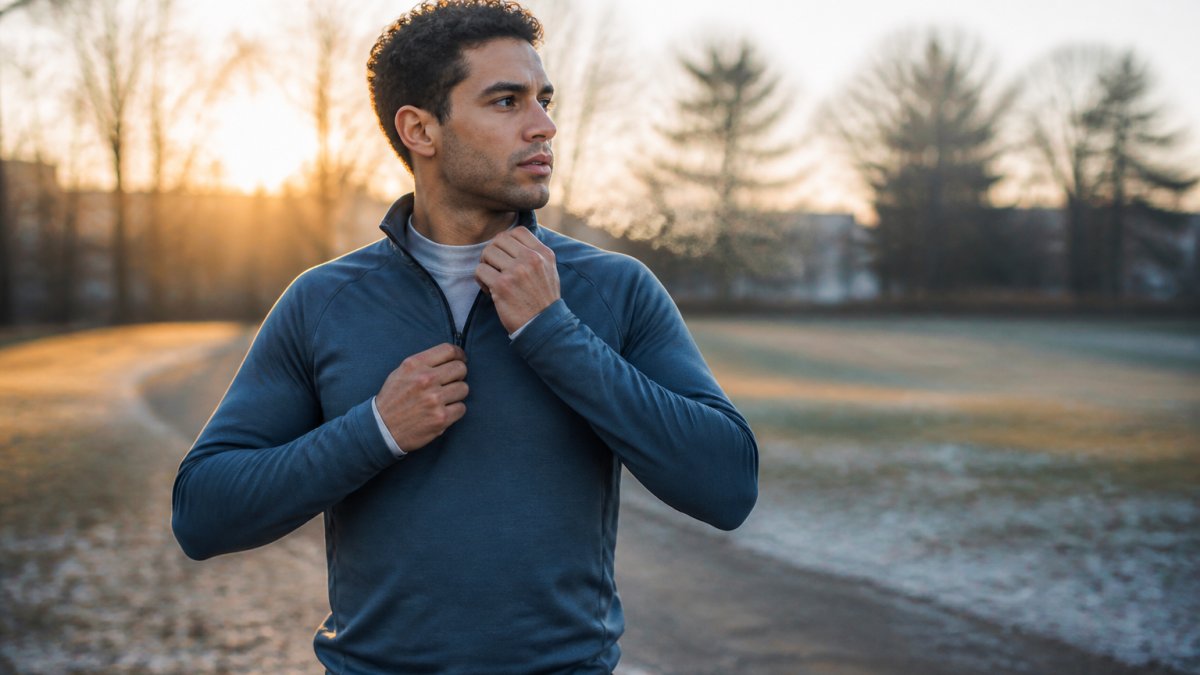
A quarter zip is the best cold-weather running layer because it protects your core while venting heat from your chest and neck.
The collar and zipper do the work. Zip up against the wind on an open stretch. Unzip on a climb.
Performance Training Quarter Zip →
Cold-weather running also demands mobility. A simplified quarter zip moves with your arms instead of catching on them.
Our Performance Training Quarter Zip is built for exactly this: a smooth surface, lightweight durability, and extra breathability, worn with or without a tee.

The Best Midlayer for Training: Fit, Fabric, and Mobility
The best midlayer for training fits close without being tight, uses a breathable technical fabric, and lets your shoulders move through a full range. Fit matters as much as fabric, and for layering, it matters more, because a midlayer has to leave room for a base layer without turning you into a bundle.
Fit checkpoints, in order
- Shoulders: seams should sit at the joint, not pull across it. If the seam rides up toward your neck when you raise your arms, the layer is too small.
- Chest: close to the body but not stretched. You should be able to slide a flat hand under the fabric at the sternum without strain.
- Sleeves: long enough to reach overhead without riding up past the wrist, but not so long they bunch at the cuff.
A baggy midlayer bunches under a jacket. A tight one restricts your swing or your stroke. Aim for a simplified silhouette that follows your shape.
Sizing for layering: room without bulk
The most common sizing mistake is buying a midlayer in the same size as a t-shirt and expecting it to fit over a base layer. A practical rule: size the midlayer so it fits comfortably over the base layer you will actually wear with it, not over bare skin.
A useful in-store test: put on the base layer you intend to use, then the quarter zip, then your outer shell. Raise your arms overhead, then reach across your body.
Fabric and mobility by activity
Mobility demands differ by sport, and the fabric should match:
- Running and cycling: prioritize breathability and a close fit; a lighter knit with a smooth outer face layers cleanly under a wind shell.
- Golf and racquet sports: prioritize four-way stretch through the shoulders and a hem that stays put through rotation.
- Strength training and gym work: prioritize durability and recovery; a mid-weight knit with a grid-back inner face handles repeated wear and washing.
For golfers, mobility around the shoulders is everything. A quarter zip that stretches with your swing lets you rotate freely. That's the difference between gear that works with you and gear that fights you.
When to size up, and when not to
Size up when you layer over a heavy base or a hoodie, when you want a looser casual fit, or when the fabric has little stretch.
Our Performance Training Quarter Zip is cut for exactly this kind of layering: a simplified silhouette, a smooth outer face that slides under a shell, and enough stretch to move through a full range without bunching.
Choosing the Right Quarter Zip: What to Look For
Choose a quarter zip by checking four things: fabric, fit, zipper quality, and how it layers. Get those right and you'll wear it for years.
- Fabric: look for moisture-wicking, breathable technical knits
- Fit: simplified, not tight, with room to move
- Zipper: smooth, sturdy, and easy to adjust mid-workout
Our Performance Training Quarter Zip checks every box: lightweight but durable, breathable, and ready to wear with or without a tee.
The Core Tech Quarter Zip adds an ultra-soft double-brush feel with a consistent fit, made from recycled plastic bottles.

Caring for Your Quarter Zip So It Lasts
Wash your quarter zip in cold water, skip the fabric softener, and hang it to dry. Those three habits keep technical fabric performing for years.
- Cold water protects the fibers
- No softener keeps wicking channels open
- Air dry prevents heat damage
Fabric softener is the silent killer of performance gear. It coats the fibers and blocks moisture wicking. Skip it entirely.
For a full routine, follow our seven steps to extend the life of workout clothes.
Frequently Asked Questions
Which is better for layering: a quarter-zip or a hoodie?
A quarter zip beats a hoodie for layering in most training scenarios. The half-length zipper gives adjustable ventilation, so you can dump heat mid-workout without removing a layer. Hoods add bulk at the neck and trap heat, which gets uncomfortable during hard efforts. A quarter zip also slides under a jacket or vest more cleanly. For rest days or casual wear, a hoodie is fine, but for training and cold-weather layering, quarter zips win on breathability and mobility.
Are quarter zips good for running?
Yes. Quarter zips for running work well because the zipper lets you regulate temperature as your body heats up. Start zipped, then open it as you warm up. Look for moisture-wicking performance fabric and a fit that allows arm swing without bunching. A quarter zip also layers easily under a windbreaker or vest on colder runs. Avoid cotton blends, which hold sweat and chill you when you slow down.
What should you wear under a quarter zip?
A moisture-wicking base layer or performance tee is the right choice under a quarter zip. The base layer moves sweat away from your skin, while the quarter zip adds warmth and breathability on top. In mild conditions, a quarter zip alone over a tee is enough. In cold weather, add a base layer underneath and a windproof outer layer on top. Skip cotton underneath, since it stays wet and pulls heat from your body.
Are quarter zips warm enough for cold-weather training?
A performance quarter zip works as a midlayer in cold weather, not a standalone winter coat. Worn over a base layer and under a jacket or vest, it traps warmth while letting moisture escape. For temperatures near freezing, pair it with an insulated outer layer. The adjustable zipper helps you cool down as your body heats up during training, which keeps you comfortable across changing conditions.
Layering well is a skill, and the right midlayer makes it easy. Greatness Wins builds performance quarter zips that regulate temperature, move with you, and last through heavy use. Our gear is designed to help you reach your personal best, with free shipping on orders over $100 and free returns within the U.S. Get started with Greatness Wins and train in gear that keeps up.