Quick Summary
Four-way stretch golf fabric stretches along both the width and the length of the cloth, so it moves with your shoulders, hips, and torso through the backswing and follow-through. Good recovery keeps the shirt in shape over 18 holes. Look for stretch in both directions, reliable recovery, and a fit suited to your swing.
- Four-way stretch extends along two axes, so it moves with your shoulders, hips, and torso together.
- Recovery matters as much as stretch, since it keeps the shirt in shape across a full round.
- Test fabric by stretching it diagonally, the way your back and shoulders load during the swing.
- Heat and repeated washing degrade elastane, so follow the care label to protect the fit.
Table of Contents
- What Four-Way Stretch Means for Golf Fabric
- 1. Full Range of Motion Through Your Backswing and Follow-Through
- 2. Comfort That Holds Up Over 18 Holes
- 3. Breathability and Moisture Management in Warm Weather
- 4. Shape Retention, Recovery and Long-Term Wear
- Two-Way vs. Four-Way Stretch: Where the Trade-Offs Lie
- Choosing the Best Fabric for Golf Shirts
- Your Next Step: Shop the Golf Range at Greatness Wins
- Frequently Asked Questions
What Four-Way Stretch Means for Golf Fabric
Last Updated: October 30, 2026
Four-way stretch golf fabric stretches in both directions across the width and the length of the cloth. That means it gives when you turn, reach, and finish a swing, then returns to its shape.
Stretch alone is only part of the story. Recovery is what keeps a shirt looking right after a full day of swings. Comfort also depends on recovery, meaning the fabric's ability to return to its shape after stretching. So the right question is not just "does it stretch?" but "does it stretch, return, and hold up?"
Four-way stretch means fabric extends along two axes, not just one, so the cloth moves with your shoulders, hips, and torso together.
Here is what to look for when you check a product:
- Stretch in both directions, not only side to side
- Good recovery, so the shirt returns to its shape
- A knit that moves without feeling tight or loose
- Fit that suits your swing, not just your standing posture
1. Full Range of Motion Through Your Backswing and Follow-Through
Four-way stretch matters most at the two extremes of the swing. A golf swing asks the fabric to do several different things in sequence, and a knit that only stretches one way will bind somewhere in that chain.
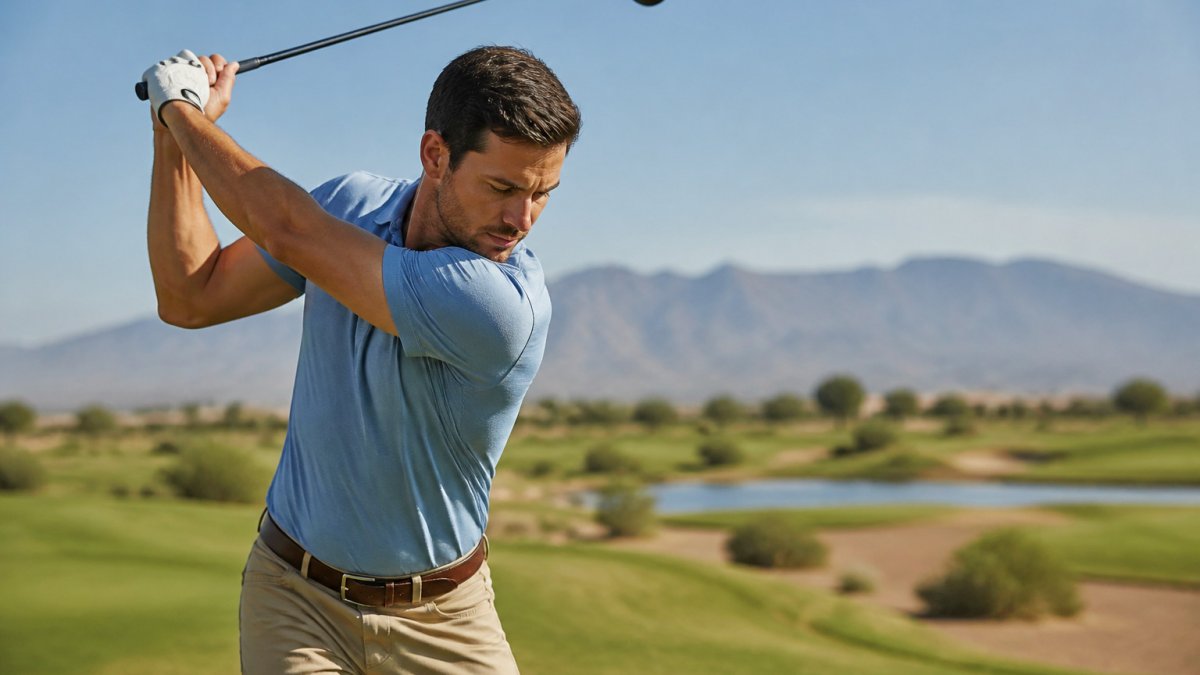
Here is how four-way stretch maps to the actual movements:
- Backswing shoulder turn. As your lead shoulder rotates under your chin and your trail shoulder pulls back, the fabric across the upper back and chest has to lengthen diagonally. Four-way stretch lets the cloth give along both the length and width of the panel, so the shoulder line can rotate without the shirt pulling tight across the chest or riding up at the waist.
- Top-of-backswing reach. At the top, your arms are extended and your torso is coiled. A two-way knit often resists here because the stretch runs mainly side to side, while the pull is diagonal.
- Downswing and follow-through. The follow-through is the opposite extreme: your torso rotates through, your arms extend across your body, and your lead side lengthens. Fabric with good recovery returns to shape as you settle into your finish instead of staying stretched out.
- Bending, walking, and sitting. A round is not one swing. You bend to tee a ball, crouch to read a putt, walk between shots, and sit in a cart. Four-way stretch is designed to move with you through those movements.
If you want a deeper look at shirts built for a full swing, read Golf Shirts That Allow Full Swing: A 2026 Guide before you shop.
2. Comfort That Holds Up Over 18 Holes
Comfort during a round is about more than the first hole. Fabric that stretches well but loses its shape by the back nine can feel tight or sag. Recovery is the detail that keeps a shirt comfortable from the first tee to the last green.
3. Breathability and Moisture Management in Warm Weather
Warm-weather rounds put moisture-management fabric to the test. A four-way stretch knit that wicks sweat away from the skin helps you stay drier and more comfortable as the day heats up. Greatness Wins' Athletic Tech Stripe Polo is designed with moisture-wicking technology.

4. Shape Retention, Recovery and Long-Term Wear
A shirt is only worth the price if it lasts. Check fabric specs and construction, and care for the garment as directed, to protect its shape over time. Read more about what makes athletic wear durable for golf before you decide.
Two-Way vs. Four-Way Stretch: Where the Trade-Offs Lie
Two-way stretch moves along one axis, usually side to side. Four-way stretch moves along two, which gives more freedom through the swing. That extra freedom is real, but it is not free. Understanding the trade-offs helps you pick the right fabric for how you play and how you care for your clothes.
Stretch versus structure. A more elastic knit tends to feel softer and more forgiving, but it can also feel less structured than a firmer woven. Some players prefer a shirt that holds its shape crisply at the collar and placket; others want the shirt to move like a second skin. Neither is wrong, but a highly elastic fabric may drape rather than stand away from the body.
Stretch versus durability. Elastane is what gives a fabric its stretch and recovery, and it is also the component most sensitive to heat and repeated washing. A fabric with a high stretch percentage can feel great on day one, but if the elastane degrades, the garment loses recovery and starts to sag. That is why care instructions matter as much as the stretch number on the label.
Stretch versus breathability. A dense, high-stretch knit may feel supportive but trap heat, while a more open knit breathes better but offers less structure. If you play in warm conditions, look for a stretch fabric that also specifies moisture wicking and airflow rather than assuming stretch equals breathability.
Stretch versus support. Four-way stretch gives freedom of movement. Check whether the garment is cut to provide hold or to feel relaxed.
The practical test. You can compare fabrics at home before you commit. Hold a section of the fabric and stretch it along the length, then across the width. Both should give. Release it and see whether it snaps back to its original shape; slow recovery or a wavy, stretched-out edge is a warning sign. Then stretch it diagonally, the way your back and shoulders load during the swing. If it binds on the diagonal, it will bind on the course.
Compare synthetic and cotton golf shirts to see how each fabric handles these trade-offs, and read the care label before you buy so you know what the fabric will need to stay in shape.
The article weighs each stretch type against the others, so this table sets the main trade-offs side by side.
| Trade-off | Watch for | Practical test |
|---|---|---|
| Stretch vs. structure | Highly elastic fabric may drape rather than hold shape | Check how the collar and placket stand |
| Stretch vs. durability | Elastane degrades with heat and repeated washing | Follow the care label |
| Stretch vs. breathability | Dense high-stretch knit can trap heat | Look for moisture wicking and airflow specs |
| Stretch vs. support | Freedom of movement versus a relaxed cut | Check whether the cut is built to hold or to relax |
| Recovery | Slow recovery or wavy edges signal wear | Stretch in both directions, then release |
Choosing the Best Fabric for Golf Shirts
When you compare fabrics, start with how the shirt will be used. Consider fit, weight, and care instructions as well. You can browse the men's golf shirt range to find a style that matches your game.
- Pick four-way stretch if your swing needs full shoulder rotation
- Check that the fabric recovers after stretching
- Choose a weight that suits your local climate
- Follow the care label to protect the fit
Your Next Step: Shop the Golf Range at Greatness Wins
Frequently Asked Questions
What fabrics have a four-way stretch?
Four-way stretch is most often built from knit or woven fabrics that blend nylon, polyester and spandex (elastane). Spandex supplies the elasticity, while nylon or polyester gives the fabric durability and quick-drying properties. Check the fabric label for the spandex percentage, since a higher share usually means more stretch and faster recovery. Four-way stretch means the fabric stretches horizontally and vertically, so it moves with you in every direction during a swing.
What is the difference between two-way and four-way stretch fabric?
Two-way stretch fabric gives in one direction, typically side to side across the width of the fabric. Four-way stretch adds the vertical direction, so the fabric also extends up and down. For golf, four-way stretch matters because the swing combines rotation of the shoulders, hips and torso with bending and reaching. Two-way fabric can still work for simpler garments, but four-way is the better choice for a full swing.
Is four-way stretch fabric breathable enough for golf?
Breathability depends on the knit structure and the fiber blend, not on stretch alone. Many four-way stretch golf fabrics use lightweight knits with moisture-wicking polyester that move sweat to the surface, where it evaporates. Look for a lightweight, quick-drying construction and test the fabric by stretching it: a tight, dense weave will breathe less than an open knit. When in doubt, choose a lighter fabric for warm weather rounds.
How should a golf shirt fit to allow a full swing?
A golf shirt should fit close to the body without pulling at the shoulders, chest or back when you raise your arms. Try a simple at-home test: stand with your arms straight out to the sides, then reach forward and rotate as if swinging. If the shirt pulls across the shoulders or lifts from the waistband, size up or choose a four-way stretch cut. Fit and stretch work together, so a stretch fabric in the wrong size still restricts movement.
Ready to play with more freedom? Start with the Athletic Tech Polo, built for full range of motion and superior moisture-wicking. Shop all golf at Greatness Wins and find the fit that matches your swing.