Last Updated: October 27, 2026
Quick Summary
Essential golf clothing features include moisture-wicking fabrics like polyester blends that pull sweat away, breathability through mesh panels and open weaves that allow evaporation, and four-way stretch for full swing mobility. These golf clothing features keep you dry, cool, and focused throughout 18 holes.
- Moisture-wicking polyester and synthetic blends move sweat faster than cotton, preventing pooling and keeping you cooler.
- Breathability depends on knit structure, fabric weight, and ventilation zones like mesh inserts and perforated panels, not marketing labels alone.
- Four-way stretch and ergonomic cuts enable full range of motion without restricting your swing.
- Light colors and UPF ratings manage heat and UV exposure in warm-weather conditions.
- Quick-dry synthetic fabrics dry 3-5 times faster than cotton, reducing fatigue over extended play.
Table of Contents
- Moisture-Wicking and Sweat Management in Golf Apparel
- Breathability and Ventilation for Sustained Comfort
- Stretch and Mobility: Golf Clothing Fit for Your Swing
- Performance Golf Shirts: Lightweight Construction and Quick-Drying Fabrics
- Golf Clothes for Hot Weather: Temperature Regulation and UV Protection
- Weather Protection and All-Weather Layering
- Building Your Essential Golf Clothing Features Checklist
- Shop Performance Golf Apparel Built for Your Best Game
- Frequently Asked Questions
Moisture-Wicking and Sweat Management in Golf Apparel
Moisture-wicking pulls sweat to the fabric surface where it evaporates.
Performance golf apparel commonly emphasizes moisture management through polyester, spandex, and nylon blends, according to Fortune Business Insights analysis of golf apparel fabric technology. Explore best moisture-wicking shirts for men to see how these fabrics perform in real-world conditions. These synthetic fibers move sweat faster than cotton, keeping you dry and focused on your game rather than your discomfort.
When you're playing 18 holes, your body generates heat through walking, swinging, and standing in the sun. Moisture-wicking fabrics prevent that sweat from pooling in your shirt or shorts, which means you stay cooler and move better. The Athletic Tech Polo from Greatness Wins(https://greatnesswins.com/products/athletic-tech-polo-11) at $99.00 delivers superior moisture-wicking technology paired with extreme lightweight construction, making it ideal for competitive rounds where every movement counts.

Breathability and Ventilation for Sustained Comfort
Two fabrics can both be labeled "moisture-wicking" and behave very differently: dense, tightly woven polyester holds vapor near the body, while open knit or mesh-backed polyester releases it. The breathability number, not the marketing word, is the useful comparison.
What actually drives breathability
- Knit structure, open weaves and mesh backers pass more vapor than tight pique or twill. A jersey knit breathes more than a densely woven performance twill of the same weight.
- Fabric weight, lighter fabrics generally breathe better, but only if the weave is open. A 3.0 oz tight weave can breathe worse than a 4.5 oz open mesh.
- Ventilation zones, perforated panels, mesh inserts at the back yoke, underarm gussets, and drop tails create dedicated exhaust paths where heat concentrates.
- Backing and lining, a mesh liner under a shell adds airflow; a solid bonded lining blocks it.
- Fit, a garment that clings traps a humid microclimate. A slightly relaxed cut with a drop tail lets air circulate and prevents the fabric from plastering to your back at address.
Breathability by garment type
- Polos and shirts: Look for mesh back yokes, perforated side panels, and open-knit pique. A back drop tail adds coverage and airflow at the same time.
- Shorts and trousers: Ventilation usually comes from gussets, laser-perforated panels behind the knee, and lightweight stretch twill. A short with a mesh liner breathes noticeably better than an unlined woven.
- Base layers: The thinnest, most open knit you can tolerate. A base layer that does not breathe defeats the layers above it.
- Midlayers: Grid fleece or open-knit insulators breathe far better than solid fleece or bonded knits.
- Outerwear shells: Breathability is the trade-off against waterproofing. A shell rated for rain will always breathe less than an uncoated wind shirt; look for pit zips or back vents to dump heat when you are walking. Shop golf layering pieces and jackets built with SportFit fabric for warmth and wind protection without restricting your swing.
- Socks and hats: Mesh uppers and perforated crowns release heat where it builds fastest.
How to test breathability before you buy
You don't need a lab to separate real ventilation from marketing:
- The breath test: Hold the fabric up to a light and breathe through it. If you feel resistance, vapor will struggle to escape.
- The light test: More light through the weave generally means more airflow, useful for comparing two shirts side by side.
- The panel check: Turn the garment inside out. Real ventilation zones are constructed (mesh inserts, perforations), not printed or embossed.
- The cling test: Put the shirt on and reach overhead. If it sticks to your lower back, the cut is trapping heat regardless of the fabric.
The trade-offs to expect
More breathability usually means less structure, less wind resistance, and sometimes less durability. Match the fabric to the conditions: open knits and mesh for heat, denser weaves and shells for wind and rain.
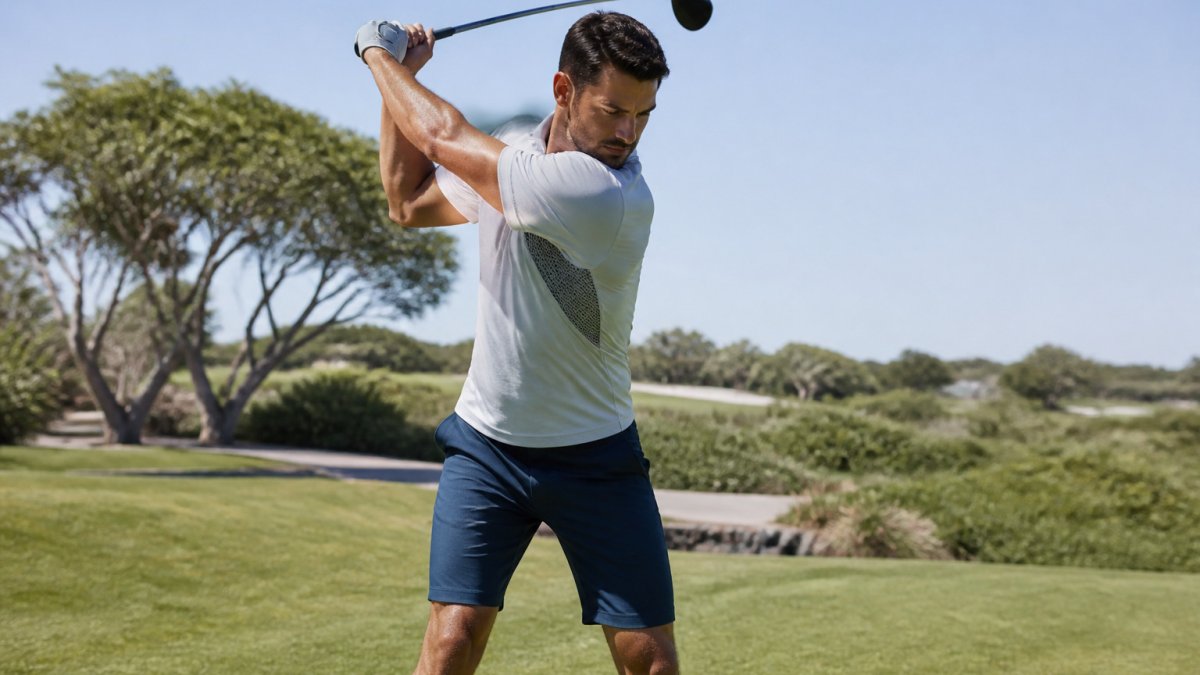
Stretch and Mobility: Golf Clothing Fit for Your Swing
The Stretch Pull-On Golf Short at $98.00 is made with high-stretch ripstop fabric described as maximizing movement throughout your swing.
Performance Golf Shirts: Lightweight Construction and Quick-Drying Fabrics
The Athletic Tech Polo at $99.00 is described as extremely lightweight and offers maximum stretch for full range of motion.
Golf Clothes for Hot Weather: Temperature Regulation and UV Protection
Heat management works through three mechanisms: sweat evaporation (your primary cooling system), air circulation (breathability), and solar reflection (color and fabric). UV protection is a separate job, blocking radiation before it reaches skin, often built into the same garment but measured differently.
Temperature regulation: what actually cools you
- Evaporation is the engine. Wicking moves sweat to the surface; breathability lets it evaporate. A shirt that wicks but does not breathe just holds a wet layer against you.
- Color matters, but less than construction. Light colors reflect more solar radiation, which is why hot-weather golf apparel skews white, gray, and pastel, but an open-weave light shirt beats a dense dark one by a wider margin than color alone.
- Fit and airflow. A relaxed cut with a drop tail lets air move across your back and keeps fabric from clinging when you sweat.
- Coverage vs. exposure. Long sleeves and a wide-brim hat keep sun off skin; the fabric must still breathe or the coverage backfires.
UV protection: read the UPF number
- Built-in vs. treated: Some fabrics achieve UPF through tight weave and fiber type (built-in); others use a topical treatment that can wash out over time. Check the care label and product spec.
- Coverage counts: A UPF-rated long-sleeve polo protects more skin than a UPF-rated short-sleeve one, even at the same rating.
- Wet fabric: Stretch and moisture can reduce effective protection. A garment that fits tightly and stays wet offers less UV defense than its dry rating implies.
Hot-weather protection by garment type
- Shirts: Open-knit or mesh-backed polos in light colors; long-sleeve performance polos for maximum coverage without bulk.
- Shorts and trousers: Lightweight stretch twill with perforated panels; lighter colors reduce heat absorption.
- Base layers: Thin, open knits that move sweat and add minimal insulation.
- Hats: Perforated crowns and mesh backs release heat; a wide brim shades the face and neck.
- Socks: Mesh uppers and moisture-wicking yarns reduce heat buildup in shoes.
Care and long-term UV performance
UV protection and cooling performance degrade with poor care. Wash performance fabrics in cool water, skip fabric softener (it coats fibers and reduces wicking and breathability), and avoid high-heat drying that breaks down stretch fibers and topical treatments. Treated UPF can drop over many washes; built-in UPF holds longer, so favor construction-based protection.
A practical hot-weather checklist
Explore performance athletic gear for hot weather conditions to see how specific pieces handle temperature regulation in high-heat environments.
Weather Protection and All-Weather Layering
The 3-Layer Quarter Zip Shell Jacket at $195.00 is described as a lightweight mock-neck pullover with a simplified design for a wide range of activities and weather conditions.
Building Your Essential Golf Clothing Features Checklist
Evaluate pieces against these performance criteria rather than brand name or price alone:
| Feature | What to Look For | Why It Matters |
|---|---|---|
| Moisture-wicking | Polyester or poly-blend, mesh panels | Keeps sweat off skin, maintains focus |
| Breathability | Mesh construction, perforated panels, open weave | Allows sweat to evaporate, prevents heat trapping |
| Stretch | Four-way stretch, gusseted underarms | Enables full swing range without restriction |
| Quick-dry | Synthetic fabric, tight weave, minimal seaming | Dries 3-5x faster than cotton |
| Lightweight | Under 3.5 oz/yard fabric weight | Reduces fatigue over 18 holes |
| Temperature control | Light colors, UPF rating, ventilation zones | Manages body heat in warm conditions |
| Weather protection | DWR treatment, layering compatibility | Extends playability across seasons |
| Fit and mobility | Ergonomic cuts, high-rise waistbands, tapered design | Accommodates golf-specific body movements |
Browse the full range of men's golf shirts.
Shop Performance Golf Apparel Built for Your Best Game
The global golf apparel market is projected to grow from $9.89 billion in 2026 to $14.83 billion by 2034, according to Fortune Business Insights market analysis, reflecting growing demand for technically advanced gear. That growth is driven by golfers who recognize that performance apparel directly impacts their game.
The Clubhouse Pant at $118.00 and Clubhouse Short at $78.00 feature lightweight wrinkle-free fabric with two-way stretch and DWR water repellent treatment. The Long Sleeve Pique Polo at $125.00 is crafted from performance pique and features enhanced breathability and comfort with a back drop tail for added coverage.
Performance golf apparel isn't a luxury, it's an investment in consistency. When your clothing works with your body instead of against it, you play better. You recover faster between rounds. You stay focused when conditions get challenging. Research from Sports Medicine journals confirms that biomechanical efficiency directly correlates with athletic performance, and proper apparel removes friction from that equation.
Greatness Wins apparel is designed to help you achieve your personal best. Free shipping on orders $100+ and free returns within the U.S. Get started with Greatness Wins.
Frequently Asked Questions
What are the most important features to look for in golf clothing features for performance?
The essential golf clothing features for athletic performance include moisture-wicking to manage sweat, breathability for ventilation, four-way stretch for freedom of movement during your swing, lightweight construction for comfort, and UV protection for sun exposure. Temperature regulation through fabric technology and quick-drying capability ensure you stay focused on your game, not your discomfort. Look for technical fabrics like polyester and spandex blends that deliver these features simultaneously.
Why are moisture-wicking shirts important for golf?
Moisture-wicking shirts pull sweat away from your skin and move it to the fabric surface where it dries quickly. This keeps you dry and comfortable during your round, preventing the clammy feeling that distracts from your swing mechanics. Superior moisture-wicking technology maintains consistent body temperature and reduces the weight of wet fabric clinging to your body, allowing you to focus on your performance rather than discomfort.
How should golf clothes fit for a full swing?
Golf clothes should offer four-way stretch and maximum freedom of movement through the shoulders, chest, and torso. The fit must allow a complete range of motion without pulling or restricting your swing mechanics. Look for garments with stretch fabric that moves with your body, not against it. A buttonless, pull-on design minimizes friction and discomfort, while a classic fit that avoids excess bulk ensures you can rotate fully without fabric bunching or limiting your mobility.
What fabric technology works best for golf clothes in hot weather?
High-performance technical fabrics like polyester and spandex blends are designed for hot-weather golf. These materials offer superior breathability, ventilation, and moisture-wicking to keep you cool and dry. Look for lightweight construction that reduces fabric weight on your body and quick-drying properties so sweat evaporates rapidly. UV protection with a UPF rating shields you from sun exposure during long rounds. Performance mesh polos and wrinkle-free fabrics with DWR (durable water repellent) coating provide additional cooling and weather protection.